Showing posts with label material culture. Show all posts

Monday, 23 September 2013

Objects in Focus: The Bearnarey Obelisk


Bearnarey Obelisk
Over the course of phase IV of the Carmichael Watson Project we were able to link objects from the Carmichael collections to his written work. The following was published in the Proceedings of the Society of Antiquaries of Scotland in 1870 and presents information pertaining to how Carmichael obtained the stone and associated local lore.  

The stone of which I send a tracing has been taken from the island of Bernarey, in the Sound of Harris. It formed the upper end of an obelisk which stood in a large semicircle facing the east, near the centre of the island, at a place called Killaisem (Cilleaiseam), St Asaph. Speaking of Bearnarey, Martin, in his "Western Islands," says, - "There are two chappels in this isle, to wit, St Asaph and St Columbus's Chappel. There is a stone erected near the former, which is 8 foot high, and 2 foot thick."

About fifty years ago this obelisk was broken. Boys were in the habit of mounting to the top and swaying it to and fro, till ultimately they broke it at the surface of the ground. When it fell it broke in two pieces near the centre. These were taken away by two crofters, and placed as lintels over the entrance to a cattle-fold (cuthaidh) close at hand. After having been there for some years, they were transferred by the same men to serve a similar purpose in their dwelling-houses. I traced this piece to the house of one of these crofters, a MacKillop (MacPhilip), where it was used as a lintel over his kitchen window. MacKillop was very reluctant to allow the slab to be removed for examination, although I twice offered to replace it at my own expense. Ultimately, however, he consented. But before removing it, I thought proper to inform the proprietor, the Earl of Dunmore, of its existence, and to ask his sanction to its removal from the island. His Lordship immediately wrote his factor to secure the slab, and bring it to Rodail. Upon his Lordship's arrival in Harris he wrote me, expressing his interest in the stone, and giving his permission to make what use of it I pleased. I got the slab removed from Rodail to Lochmaddy, where it now lies. 

It is dark bluish-gray gneiss, and measures 3 feet 8 inches long, 19 inches broad, and 3 inches thick. The upper portion of the carving forming the square is sufficiently distinct to be easily traced, but the lower portion is more defaced, and in some places the surface of the stone is entirely broken. How far the carving extended on the other part of the obelisk there is at present no means of ascertaining. The crofter who had it, feeling some remorse, restored it to the place where he found it. He alleged that a carlin of ugly form and features visited him one night, and entreated and commanded him to return the obelisk of Cillaiseam, St Asaph, otherwise he would suffer here and hereafter. The man went early the following morning, apparently much troubled, and entreated MacKillop to restore his part of the stone. MacKillop replied that his part of the slab was of much use to him; that he had no vision; and that he would defer returning it till the ugly carlin honoured him with a visit. The other man returned his part, and shortly thereafter went to America, where he died. Some other person less scrupulous took away this part of the stone, which I have hitherto failed to trace.

The old people of Bernarey have told me that within their memory the base of the obelisk was surrounded with a heap of small, beautifully white, and variegated pebbles, old coins, bone pins, and bronze needles, the offerings of pilgrims at the shrine of St Asaph.

MacKillop, on whose croft the obelisk stood, told me that in delving the place preparatory to sowing corn, he was in the habit of turning up a number of bones. There is no trace now of the "chappel" mentioned by Martin, nor indeed of any building whatever. The place is in the corner of a field, and has been under cultivation for some years. Close by the side of the obelisk there stood one of those old circular duns so common in the Hebrides. I would have inferred that this was the remains of the "chappel," were it not that MacKillop told me that it contained wall passages and galleries common to these duns. All the stones were carried away for building materials.  

The slab is currently housed in storage with the National Museums of Scotland.

Reference 
Allen, J. R.and Anderson, J. Early Christian Monuments of Scotland (Edinburgh, 1903) pp.113Carmichael, A. 'Notices of Teampull Michael, Keallun, North Uist, and of Sculptured Stones in Bearnarey, Harris, and in Benbecula; an "Abrach" Quern and Quarry for Querns, Heisgeir, North Uist, &c', Proceedings of the Society of Antiquaries of Scotland, VIII, (Edinburgh, 1870) p.281.

Image 
Copyright National Museums of Scotland  

Monday, 22 July 2013

Objects in Focus: Querns

Quern stones were popularly used throughout Scotland, to grind and mill cereals, into the twentieth century. A complete rotary quern consists of an upper and lower quern stone that were used simultaneously. Within the Carmichael Collection there are two quern stones, not a pair, that were donated to the Society of Antiquaries of Scotland. Carmichael's notes on one of the quern stones in the collection at the National Museums of Scotland are available to read here. 
X.BB 24 Upper stone from a granite disc quern

An early form of the tool was the saddle quern and comprised of a large stone to place the grain on and a rubbing stone to do the grinding. The consistent grinding created a characteristic depression on the main stone. The Romans introduced the rotary quern to Britain, This variation of the tool was less labour intensive. These rotary querns stones are disc-shape and the upper stones always has a central hole and either a hollow or smaller hole. To grind down the cereal the grain was fed in through the central hole of the upper quern stone. Rotation was done by hand with a handle that was positioned in a hollow on the upper stone while the lower stone remained stationary.  Grain was crushed between the two stones, pushed to the edge of the stone and caught on a cloth or table under the quern. The result was a mixture of flour, grains and husk that was often processed two or three times to achieve the required fineness.

A hard type of stone, for example granite, was necessary for the quern because the constant grinding would erode softer stone types. The upper face of the top stone is often decorated with concentric grooves and chiselled lines. 
X.BB 25 Rotary quern stone, underside
A definition by Dwelly of the Muileann-brà [quern]:
 
The quern was formerly the only mill for corn-grinding used in the Gàidhealtachd. It is still in use in many parts of northern Europe and in Asia, and the "two women finding at the mill" (quern) may be seen to-day in Nazareth exactly as they were in the days of Christ. The implement consists of two stones, the lower being about two feet in diameter, and commonly hollowed to the depth of about six inches. This hollow is of equal depth and diameter. Within this is placed horizontally, a smooth round flag about four inches thick, and so fitted to the cavity that it can just revolve with ease. Through the centre of this revolving flat there is bored a hole for conveying the grain. In the lower stone, in the centre of its cavity, there is fixed a wooden pin on which the upper stone is placed in such exact equiponderance, that, though there be some friction from their contact, a little force applied will make the upper stone revolve for several times, when there is no grain underneath. On the surface of the upper stone, and near the edge, are two or three holes, just deep enough to hold in its placed the stick by which it is turned round.  The working of the quern is left to the women, two of whom, when the grain is properly dried, sit squatting on the ground, with the quern between them and singing loudly an appropriate song, perform their work, one turning round the stone with the handle placed in one of the holes, and the other dropping the corn in through the large hole. The law of Scotland attempted in vain to discourage the use of the quern. In the year 1248 it was enacted "that no man shall presume to grind quheit, maisloch or rye, with hand mylnes, except he be compelled by storm, and be in lack of mylnes quhilk should grind the samen; and in this case, if a man grinds at hand-mylnes, he shall give the threttein measure as multer; and gif any man contravein this our prohibitions, he sall tyne his hand-mylnes perpetuallie."

X.BB 25 Rotary quern stone, upperside
As noted in the dictionary definition, women performed the task of grinding the grains and sang during the process. In the notebooks there are numerous references to quern-related songs collected by Carmichael: a quern song, a fairy quern song overheard in Berneray and a song collected from Catherine MacFarlane while she was grinding the quern. The fairies are regularly associated with querns and the spindle whorls used in spinning wool were often referred to as fairy querns. 

References
CW90/95
CW120/383
CW150/26 
Dwelly, E. The Illustrated Gaelic-English Dictionary (Glasgow, 1994)
Images
©National Museums Scotland (www.nms.ac.uk)

Wednesday, 19 June 2013

Objects in Focus: Cas-chrom

Cas-chrom
Carmichael's collection contains a vast array of objects including a cas-chrom, a foot-plough, that is on display at the Museum of Rural Life, East Kilbride. This agrestic implement was commonly used throughout the Highlands and Islands of Scotland to prepare and cultivate the soil. It was particularly useful on stony and boggy surfaces where horses or men could not easily manoeuvre a plough. The tool had a dual function as it served not only as a plough but also as a spade. Interestingly the cas-chrom , that literally means crooked foot, was called a cas-chaba in Applecross only, and the head of the plough was referred to as meirgheal.   

L. C. Hopkins writing in the Journal of the Royal Asiatic Society of Great Britain and Ireland, 1935, described the plough as recently obsolete, if indeed it is even now absolutely disused in some remote spots in Northern or North-western Scotland. He also had initially proposed that nothing can be termed a plough that is not hauled from in front (whether by oxen, yaks, horses, or even men) until the cas-chrom came to his attention. From various accounts it appears that the Isle of Skye was one of the last places the tool was used in the early twentieth century.  

The following is a proverb and note related to the cas-chrom recorded by Alexander Nicolson, 1882:
Caib air no dheth, cùm do chas air a' sgonnan.
Iron on or off, keep your foot on the peg.

The 'caib' of the old crooked spade, 'cas-chróm', was the iron with which it was pointed; the 'sgonnan' was the peg on which the right foot was pressed. The meaning is, 'Keep working, even with a defective implement'.  

And the following verses were published in Carmina Gadelica vi and the informant was obviously not a fan of the labour intensive tool:

Coma liom a' chas-chrom.                                                                    I dislike the crooked spade,
Nar bheil fonn fearann dhi;                                                                      Nor love for land has she;
Tha i casach 's tha i trom                                                                 She is legged and she is heavy
Air gach com is anail dhiom;                                                     On every chest and breath of me.

Iarann geur air a ceann                                                                         A sharp iron upon its point
Chum a cur gu gearradh leis,                                                                               To set it a-cutting,
Sgonnan fiodha sìos 'na bonn                                                         A wooden peg down at its base
Chum a cur fo thalamh leis.                                                             To drive it beneath the earth.


In the Proceedings of the Society of Antiquaries of Scotland from 1857-1589 James Johnston notes that while he was in Skye he noticed a man using this primitive tool and submitted an account of how the tool was used:

The ' cas-chrom,' or crooked foot, is a crooked piece of wood, the lower end somewhat thick, about 2 1/2 feet in length, pretty straight, and armed at the end with iron, made thin and square to cut the earth. The upper end of this instrument is called the shaft, whereas the lower is termed the head; the shaft above the crook is generally straight, being 6 feet long, and tapering upwards to the end, which is slender ; just below the crook or angle, which is an obtuse one, there must be a hole, wherein a strong peg must be fixed for the workman's right foot, in order to push the instrument into the earth, while, in the meantime, standing upon his left foot, and holding the shaft firm with both hands, when he has in this manner driven the head far enough into the earth with one bend of his body, he raises the clod by the iron-headed part of his instrument, making use of the heel or hind part of the head as a fulcrum,—in so doing turns it over always towards the left hand, and then proceeds to push for another clod in the same form.

While it was thought to be time-consuming for large areas of land the advantage of the cas-chrom was indeed that it allowed crofters to work land that was otherwise ignored. Macdonald writes: 'Cottars and very small tenants may use it, however, very profitably, both in providing food for their families, and in bringing into a permanent state of improvement, for their masters, lands which otherwise would remain always unproductive and useless.'

For more information on the 'crooked foot' see the catalogue entry on the Carmichael Watson Project website, anseo. And we would also highly recommend a visit to the Museum of Rural Life, a great day out!


References
Armstrong, Robert Archibald, A Gaelic Dictionary in Two Parts (London, 1825) p.103. 
Carmichael, Alexander, Carmina Gadelica vi (Edinburgh, 1971) pp.36-37.
Hopkins, L. C. 'The Cas-chrom v. the Lei-ssŭ: A Study of the Primitive Forms of Plough in Scotland and
Ancient China', Journal of the Royal Asiatic Society of Great Britain and Ireland, 4,(1935) pp. 707 - 716.

Macdonald, James, General View of the Agriculture of the Hebrides (1821) pp.151-156.Nicolson, Alexander A Collection of Gaelic Proverbs and Familiar Phrases based on MacIntosh's Collection (Edinburgh, 1882) p.382.  
Proceedings of the Society of Antiquaries of Scotland iii (1857-1589).

Image
© National Museums of Scotland

Wednesday, 24 April 2013

Preview of the catalogue

This Friday the Carmichael Watson Project object catalogue, based on Carmichael's collections at the West Highland Museum and the National Museums of Scotland, will be going live!

Over the past year the team have been locating, researching, photographing and cataloguing all the objects, and a select few were featured in blog entries. Altogether the collections contain more than 440 objects from the smallest coin to a large carved stone slab.

Here's a hint at what others objects are in the catalogue: 
Carved Stone Slab, National Museums of Scotland

Swatches of tartan cloth, National Museums of  Scotland
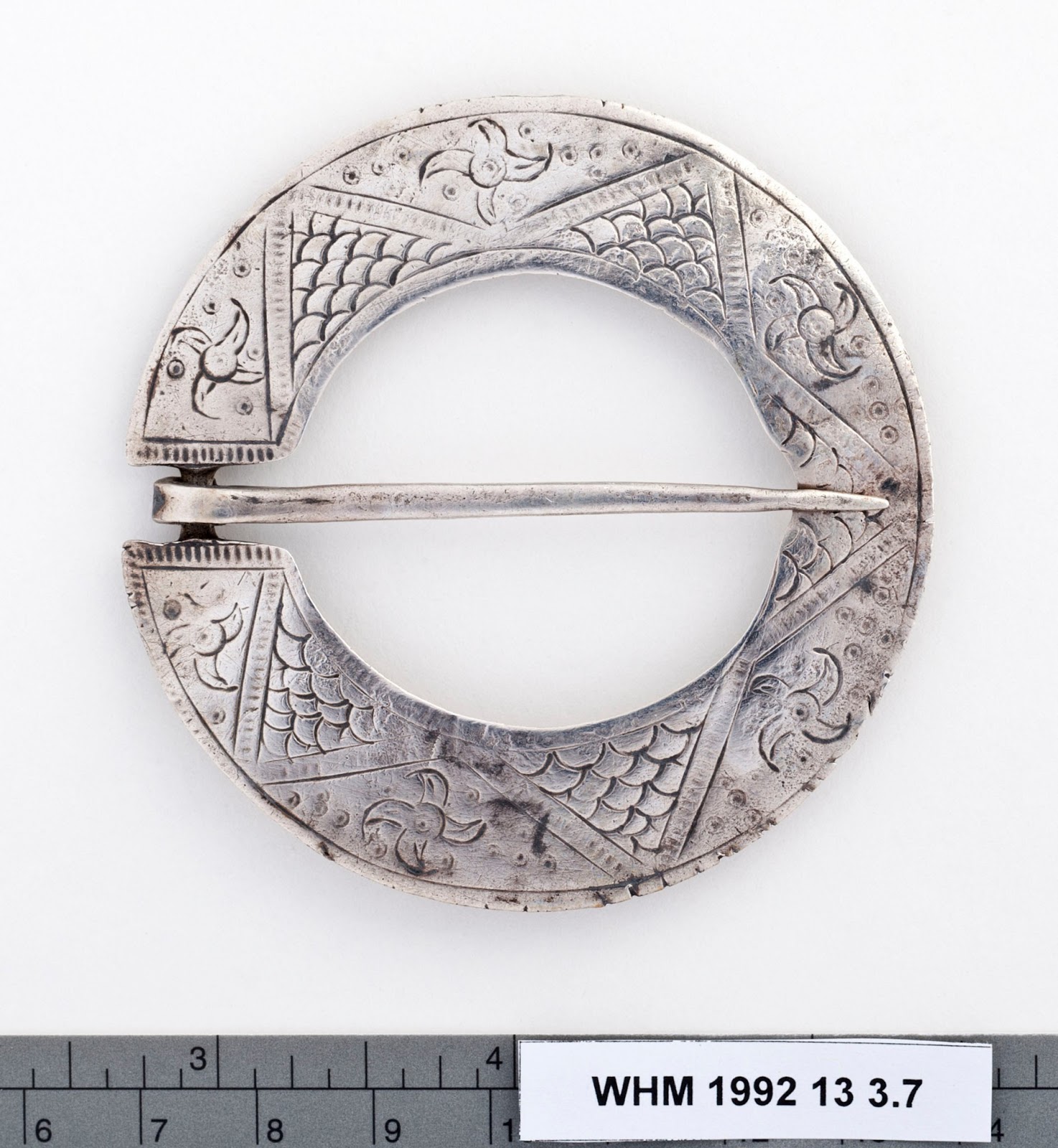
Copper Alloy Brooch, West Highland Museum

Silver Luckenbooth Brooch, West Highland Museum

Copper cup, West Highland Museum

Spanish coin and Roman coin, West Highland Museum

Snàithle, West Highland Museum

Basket-hilted sword, West Highland Museum

Silver Ring Brooch, West Highland Museum
Images
NMS objects © National Museums of Scotland
WHM objects  © Carsten Flieger 

Friday, 12 April 2013

Objects in Focus: Stone Font


In the National Museum of Scotland, Edinburgh a handful of objects collected by Carmicahel are on display: a baptismal font, a stone font and a Pictish stone. Carmichael's own notes explain where the stone font was found and the particular curing beliefs associated with it.  
Stone font
The small primitive porous looking font is from Christ's Burying Ground (Cladh Chriost) in the Island of Pabbay, Barra. 

Like the other islands of Barra, Pabbay is extremely rugged and precipitous and except during settled weather inapproachable on account of the Atlantic surf. On the south east side of the island there is an open bay. Behind this surf-beaten bay and in front of this glaciated hill beyond is a semicircular valley the bottom of which on the north side is composed of deep accumulated sand drift. 

This was formerly covered with bent (muran) and other grasses but the surface breaks caused by the winter storms have been inattended to of late years, the winter winds have swept away the sand to a great depth leaving studded over the valley high cone-like mounds as monuments of neglect. Cladh Chriost is one of these cone-like mounds. It is about thirty feet high and composed or built up of many successive and distinctive layers of sand, like so many different pieces of bleached and unbleached cotton on a drapers shelf and pointing to different periods of formation. 

Its base has already become considerably hard and solid thus affording us the late and interesting opportunity of examining the slow and silent yet sure and inevitable process by which Time converts the flying particles of sand into hard and solid rock. Had no fortuitous circumstances prevented this sand mound would be converted into sand stone rock, in which would be embedded at various distances from the surface well preserved human remains, some of them surrounded by rows of carefully selected polished pebbles from the strand, and others by irregularly coarse common moor stones from the hill; innumerable bits of cinerary urns, of different manufactures and evidently of different periods with pins and needles, of bone, bronze and brass.

Stone font
And in the event of these hard memorials of man surviving like the tender lady from the process of petrefaction, perchance some future Hugh Miller might arise in the distant ages to draw therefrom lessons of utility instruction and wisdom.

A stream flows from the scariated hill behind which strikes during spates with considerable force against the rear of Cladh Chriost after which it skirts round the base thereof undermining and carrying in its sacrilegious course, the crumbling mound of sand, human remains, and human memorials, in one confused mass, into the continuous and tumbling, toiling, troubles sea below.

Embedded in the grassy sandy summit of this disused and neglected burying ground, this simple font rested for ages. But having been lost to sight of late, a search was made for it two years ago, at my request which resulted in finding it in the bed of the stream beneath, upon which it was obligingly transmitted to me to Lochmaddy.

This font was for centuries an object of credulous belief to the inhabitants of Pabbay and the other southern Isles of Barra. These simple people implicitly believed that the touch of this font like that of another stone in S. Mary’s burying ground (Cladh Naomh Moire) in the neighbouring island of Bearnaray (Barra-Head) was efficacious in preventing and removing many mental and physical disorders incident to themselves and their flocks. The lixivium found in the font was considered doubly consecrated, firstly through contact with the already consecrated font, and secondly through the friendly agency of some invisible and mysterious power that presided over the scene. The virtues of this salinated water were deemed secondary only to those of the water consecrated by the priest. 

The people rubbed their bodies and their cattle with the font and sprinkled themselves and their flocks with the water contained therein, for the cure of certain bodily ailments and for the prevention of specific acts of witchcraft. And when this ceremony was duly performed with the necessary amount of formality and with the necessary admixture of pagan and christian rites, the people firmly believed that creative spirits of the air, nor the witches of the earth, nor the mermaids of the deep surrounding sea could infuse or molest them. 
Pabbay, Barra
A charm so potent could not be otherwise than an object of deep awe and interest among the hardy, simple and kind hearted people possessing it nor do I doubt but an attempt to remove it eighty or a hundred years ago would have been stoutly resisted and would probably result in serious consequences. But – “Old times are changed, old manners gone, A stranger fills the Stewarts’ throne; The bigots of an iron time, Had called these harmless acts a crime.” 

For a number of years past the belief in the virtues of this charm has been falling into abeyance and now only two old men as far as I know can give an intelligible account of the faded glories of the primitive little font. 

Now, the next time you visit the museum on Chambers Street keep an eye out for this font!

Reference
GB 237 Coll-97 CW457
Images
Font: © National Museums of Scotland
Pabbay: © RCAHMS

Tuesday, 19 February 2013

Innovative Learning Week 2013

Image


Innovative Learning Week at the University of Edinburgh is a week-long programme of learning events that provides students with an exciting opportunity to learn in a creative and informal way.  
ILW2013 aims to encourage undergraduate and postgraduate students to:

  • gain a new perspective on your degree subject
  • learn new skills
  • think about a future career
  • exchange ideas and stimulate debate
  • meet staff and students from different Schools and Colleges
  • network and find new opportunities for research or revision

Domhnall Uilleam and Guinevere from the Carmichael Watson Project prepared a workshop about the charms in the Carmichael Collections. Drawing on both the archive here at the Centre for Research Collections and the object collection at the West Highland Museum, the workshop discussed both the verbal charms and the amulets.  

The session began by outlining the various shapes and sizes a charm can take from a stone to a brooch to an incantation. The term charm is so loose that it can be applied to a wide range of objects that were believed to generate protective, curative, attractive or maleficent power.


Carmichael, over the span of his folklore career, recorded around 60 charms and considering the privacy and personal aspect surrounding charms this is quite a substantial and pertinent collection.  These charms can be found in Carmina Gadelica and in his notebooks that are available on the project's online catalogue, and there are charms for all sorts of problems from toothache to broken bones! There are some recorded verbal charms that were collected in the 1960s and 70s accessible via Tobar an Dualchais: Eòlas an Dèididh, Chanadh neach an rann seo trì uairean, Tha am fiosraiche ag aithris seun.


Carmichael also collected charm objects that were used throughout the islands. A number of these objects have been highlighted in previous blogs such as the whorls, flint arrowheads and sea-beans. There was also a mention of the use of domestic and agrestic tools doubling up as divination devices, namely the winnowing riddle that was used to predict a future spouse! 


The workshop finished up with a discussion about the use of charms today, and the decline in their use, and superstitions. One participant shared a belief from Southern Florida with the group: when a cat passes in front of a car, a cross must be marked on the windshield to prevent bad luck! 

It was a really enjoyable session with a good discussion and we'd like to thank those who came along. 

A review of the session is available to read on the Innovative Learning Week 2013 blog: click here.

Image
Copyright Carsten Flieger 

Stone whorls WHM 1992 13 2.4

Stone whorls WHM 1992 13 2.4
Stone whorls collected by Alexander Carmichael, held by West Highland Museum (ref. WHM 1992 13 2.4). [© carstenflieger.com]