Showing posts with label National Museum of Scotland. Show all posts

Monday, 22 July 2013

Objects in Focus: Querns

Quern stones were popularly used throughout Scotland, to grind and mill cereals, into the twentieth century. A complete rotary quern consists of an upper and lower quern stone that were used simultaneously. Within the Carmichael Collection there are two quern stones, not a pair, that were donated to the Society of Antiquaries of Scotland. Carmichael's notes on one of the quern stones in the collection at the National Museums of Scotland are available to read here
X.BB 24 Upper stone from a granite disc quern

An early form of the tool was the saddle quern and comprised of a large stone to place the grain on and a rubbing stone to do the grinding. The consistent grinding created a characteristic depression on the main stone. The Romans introduced the rotary quern to Britain, This variation of the tool was less labour intensive. These rotary querns stones are disc-shape and the upper stones always has a central hole and either a hollow or smaller hole. To grind down the cereal the grain was fed in through the central hole of the upper quern stone. Rotation was done by hand with a handle that was positioned in a hollow on the upper stone while the lower stone remained stationary.  Grain was crushed between the two stones, pushed to the edge of the stone and caught on a cloth or table under the quern. The result was a mixture of flour, grains and husk that was often processed two or three times to achieve the required fineness.

A hard type of stone, for example granite, was necessary for the quern because the constant grinding would erode softer stone types. The upper face of the top stone is often decorated with concentric grooves and chiselled lines. 
X.BB 25 Rotary quern stone, underside
A definition by Dwelly of the Muileann-brà [quern]:
 
The quern was formerly the only mill for corn-grinding used in the Gàidhealtachd. It is still in use in many parts of northern Europe and in Asia, and the "two women finding at the mill" (quern) may be seen to-day in Nazareth exactly as they were in the days of Christ. The implement consists of two stones, the lower being about two feet in diameter, and commonly hollowed to the depth of about six inches. This hollow is of equal depth and diameter. Within this is placed horizontally, a smooth round flag about four inches thick, and so fitted to the cavity that it can just revolve with ease. Through the centre of this revolving flat there is bored a hole for conveying the grain. In the lower stone, in the centre of its cavity, there is fixed a wooden pin on which the upper stone is placed in such exact equiponderance, that, though there be some friction from their contact, a little force applied will make the upper stone revolve for several times, when there is no grain underneath. On the surface of the upper stone, and near the edge, are two or three holes, just deep enough to hold in its placed the stick by which it is turned round.  The working of the quern is left to the women, two of whom, when the grain is properly dried, sit squatting on the ground, with the quern between them and singing loudly an appropriate song, perform their work, one turning round the stone with the handle placed in one of the holes, and the other dropping the corn in through the large hole. The law of Scotland attempted in vain to discourage the use of the quern. In the year 1248 it was enacted "that no man shall presume to grind quheit, maisloch or rye, with hand mylnes, except he be compelled by storm, and be in lack of mylnes quhilk should grind the samen; and in this case, if a man grinds at hand-mylnes, he shall give the threttein measure as multer; and gif any man contravein this our prohibitions, he sall tyne his hand-mylnes perpetuallie."

X.BB 25 Rotary quern stone, upperside
As noted in the dictionary definition, women performed the task of grinding the grains and sang during the process. In the notebooks there are numerous references to quern-related songs collected by Carmichael: a quern song, a fairy quern song overheard in Berneray and a song collected from Catherine MacFarlane while she was grinding the quern. The fairies are regularly associated with querns and the spindle whorls used in spinning wool were often referred to as fairy querns. 

References
CW90/95
CW120/383
CW150/26 
Dwelly, E. The Illustrated Gaelic-English Dictionary (Glasgow, 1994)
Images
©National Museums Scotland (www.nms.ac.uk)

Wednesday, 24 April 2013

Preview of the catalogue

This Friday the Carmichael Watson Project object catalogue, based on Carmichael's collections at the West Highland Museum and the National Museums of Scotland, will be going live!

Over the past year the team have been locating, researching, photographing and cataloguing all the objects, and a select few were featured in blog entries. Altogether the collections contain more than 440 objects from the smallest coin to a large carved stone slab.

Here's a hint at what others objects are in the catalogue: 
Carved Stone Slab, National Museums of Scotland

Swatches of tartan cloth, National Museums of  Scotland

Copper Alloy Brooch, West Highland Museum

Silver Luckenbooth Brooch, West Highland Museum

Copper cup, West Highland Museum

Spanish coin and Roman coin, West Highland Museum

Snàithle, West Highland Museum

Basket-hilted sword, West Highland Museum

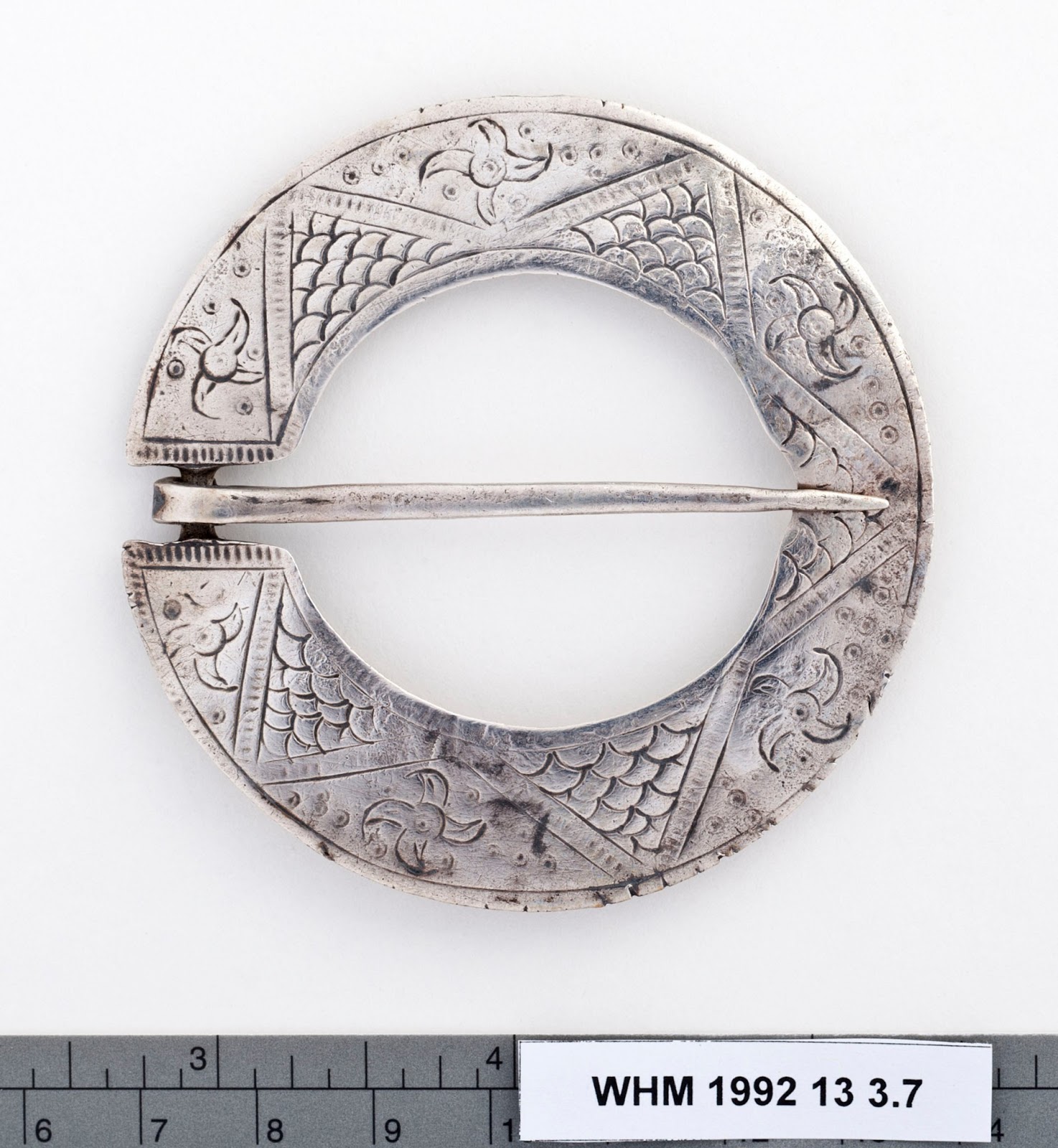
Silver Ring Brooch, West Highland Museum
Images
NMS objects © National Museums of Scotland
WHM objects  © Carsten Flieger 

Friday, 29 June 2012

St Michael's Font

  
Baptismal Font 

One of the larger items in Carmichael's collection is this baptismal font, on display at the National Museum of Scotland, Edinburgh. St Michael's font came from St Maelrubha's chapel, Eynort, Syke and is really spectacular. The carvings depict Christ on the cross, the Virgin and child (above), a bishop 'in full pontificals and crozier' and St Michael slaying a dragon. If you get a chance do pop into NMS to see it.

There is a reference in the notebook to the font (CW104/27), and in a blog entry from April 2010 the account of how Carmichael came to have the font is available. But recently I came across another account of how he came to receive the font and thought it would make a great blog! Otta Swire, from Skye, records in her book Skye: The Island and Its Legends:

Near this same burial-ground there was once a small chapel dedicated to St Maelrhuba, patron saint of Bracadale. Like all old Skye churches, it has become a ruin; but on one night of storm towards the end of the ninteenth century a fishing boat from south Uist found itself in danger and ran for shelter to Loch Eynort. The fishermen landed and went up to the little ruined church to return thanks for their safety and to pray for good weather. There they found the old stone font with its beautiful antique carvings. They were Roman Catholics and thought it sacrilege to leave a consecrated font exposed to the weather, and, still worse, in Protestant hands, so they carried it carefully on board their boat and, the gale having dropped, put to sea. But at once the wind rose again, mountainous waves pounded the boat, and back to Loch Eynort they ran. Again the storm dropped, again they put to sea, again the wind rose and drove them back. This time it occurred to them that perhaps St Maelrhuba wanted his font and did not wish for them to remove it, so they returned it to the ruins and had a calm and pleasant voyage to Glasgow, their destination. But the font worried them. On the return journey they called again to Loch Eynort. This time they went ashore and prayed to St Maelrhuba for a sign. Did he, they asked, wish them to carry his font to south Uist as a gift to their priest and for its proper use, or to leave it in the ruins? The sun came out, a favouring breeze arose, and the fishermen took heart again and, lifting the font with great reverence, carried it once more on board their boat. This time the weather favoured them and the font was soon safely in the hands of their priest. After his death his successor gave it to the Celtic antiquarian, Mr. Carmichael, and he presented it to the Society of Antiquaries in Edinburgh, in whose museum it now rests in peace.

Quite a tale! And it is always interesting to read variations of the same story.

References
Carmichael, Alexander, 'Donation of baptismal font from Chapel of St maelruve, Lochaoineart, Skye', Proceedings of the Society of Antiquaries for Scotland, vol viii (1868-1870) pp. 237-239.
CW104/27
Swire, Otta Skye: The Island and its Legends (Edinburgh; Birlinn Limited, 2006)
Image
St Michael's font from SCRAN.ac.uk

Monday, 23 April 2012

Museum Ethnographers Group Conference 2012

The Museum Ethnographers Group was established in 1975 and their aim is to promote an understanding of museum ethnography. Membership is not restricted to museum curators; anyone with an interest in ethnography can join and be kept up-to-date via the newsletter, twitter and website.

Last week the MEG’s annual conference was held in the National Museums of Scotland, Edinburgh. This two day affair was an exciting opportunity for the team to meet up with museum folk from all over the UK and gain insight into the world of museums. The location itself was ideal (just a stone’s throw from the library!) with NMS looking inspiring after the refurbishment.

This year’s theme was 'Multiple Dialogues: interpreting ethnographic collections in the 21st century' which was of particular interest to us and Carmichael’s material collection. It was fascinating to hear the speakers and learn of the various methods for presenting and interpreting collections from all over the world. A speaker from Zeeuws Museum in the Netherlands, Caroline van Santen, spoke about a Blackfoot exhibit and how she worked closely with Clifford Crane, a Blackfoot Indian, in order to gain a greater understanding of the objects in the collection. Catherine Moore from the Powell-Cotton Museum in Kent spoke about how she worked with the Angolan community in preparation for a forthcoming exhibit ‘TALA! - Visions of Angola’.

Another interpretation of the theme was the museums’ youth programs. A number of speakers discussed their thriving programs and upcoming exhibits as chosen by the young curators (14-24 years old). Two of these young curators co-presented a talk about their exhibit entitled ‘The Curious Case of the …’ a play on the Victorian cabinet of curiosities. These programs allow them to organise the exhibit from choosing the objects, researching the selected objects, labeling, presenting and designing the leaflets. These opportunities only made me wish I was ten years younger!

The conference was a great event and it offered us a new perspective on Carmichael’s collection housed at both the West Highland Museum and the National Museums of Scotland, Edinburgh.

A brooch from the Carmichael Collection, West Highland Museum


Links
MEG
West Highland Museum
NMS

Monday, 28 November 2011

Oot an' Aboot

It's been a busy few weeks for the team as Phase 4 fever takes holds. The objects which we are cataloguing and researching are held either by The West Highland Museum (WHM), in Fort William or by the National Museum of Scotland (NMS) a few minutes up the road from the office, all of which means we've had to go oot an' aboot.

Two weeks ago, we'd a very productive afternoon with Pam Babes, Collections Development Manager and Angus Kneale, Collections System Manager at NMS looking at their cataloguing system and talking about the best approach for listing Carmichael's objects. We also got a better idea of the material we'll be dealing with there, most of which is tartan and the oddest of which is crossopus fodiens - a water shrew.


Next on the list was a trip to meet Màiri Mooney, curator at The West Highland Museum and to clap eyes on the considerably larger number of items in their Carmichael collection. The weather was hardly kind as we stepped off the train into ankle-deep puddles and driving rain but the welcome was very warm when we arrived at the museum. Many objects from the collection were out on display anyway, so we were able to start matching them to our list, which was originally drawn up to value the collection in the late 40s. What an array of artefacts! Everything from fossils to Jacobite clothing to charms to domestic tools and of course brooches. Many, many brooches. Màiri took a great deal of time with us and let us have the run of the museum for the day, so that we could plan for our next visit. High on our agenda is photographing the items - the current list has around 250 objects, so the task is a considerable one. Personal favourites from the objects we were able to see were a targe, a riding cape and knotted wool for Eòlas Snàithle [Charm of the Threads]. Seeing unfamiliar objects which have been mentioned in now very familiar manuscripts was an enlivening experience altogether.

On my own way home I took a detour to visit the project's friends at Comann Eachdraidh Lios Mòr. I mention this simply to allow me to post a picture showing how beautiful it was on the Tuesday morning!


Reference: Carmina Gadelica, vol. IV (Edinburgh, 1941) pp. 166-167.
Image 1:  Kirsty M Stewart, Màiri Mooney and Domhnall Uilleam Stiùbhart at West Highland Museum.
Image 2: Looking towards Ben Nevis from the north end of Lismore.

Stone whorls WHM 1992 13 2.4

Stone whorls WHM 1992 13 2.4
Stone whorls collected by Alexander Carmichael, held by West Highland Museum (ref. WHM 1992 13 2.4). [© carstenflieger.com]