Monday, 26 December 2011

Morag, the monster of Loch Morar - 2

After the rather straightforward texts about Morag, the monster of Loch Morar, from Alexander Carmichael’s papers which we published in our last blog, here is what seems both from the handwriting and paper to be a later description – and a much more elaborate one at that – about the mysterious creature:

Morag

The Morag dwells in Loch Morar. She gives her name to the lake and still appears when any of the old Macdonalds of Morar die. Like the other water deities she is half human half fish. The lower portions of her body is in the form of a grilse and the upper in the form of a small woman of highly developed breasts with long flowing yellow hair falling down her snow white back and breast. She is represented as being fair, beautiful and very timid and never seen save when one of the Morar family dies or when the clan falls in battle. Then she is seen rushing about with great speed and is heard wailing in great distress bemoaning and weeping the loss of the House of Morar laid desolate.
  The Morag has often brought out of their houses at night the people living along the shores of the lake and in the neighbourhood of her haunts causing much anxiety to the men and much sore weeping to the women. When the Morag was heard weeping and wailing the most thoughtless became serious and the most obdurate became subdued.
  Old [       ] Macdougall, crofter, Mallaig Bheag [said] that the horn of the steamer, the shriek of the train and the crank of the rifle were inimical to the Morag giving no peace no rest no repose to bird or beast or fish day or night driving them all from their habitats to their secret hiding places in the recesses of sea and lake and mountain.
  Macdougall described the Morag her form and face her hair and breasts her weeping and waling her rushing to and fro on the water with force and reality that carried conviction! The writer caught himself several times giving furtive glances away from his book to the calm bosom of Loch Morar in the late autumn eve. [CW493 fos.36–7]

Clearly, these aren’t field notes. The text is much more like an article or short speech worked up from earlier reminiscences. And what about Eòghan Dùghallach’s missing first name? Has Carmichael simply forgotten it (so casting doubt on the accuracy of other memories in the piece?), or has he hesitated between choosing Ewan or Hugh for his English translation?

For folklore archivists, Carmichael’s mention of ‘his book’ in passing in the final sentence is interesting. We don’t  have any extant field notebook dating to 1902 in the collection, only later transcriptions. Is the folklorist describing the scene accurately? If he is, then we have tantalising evidence for a missing Carmichael notebook. What then happened to it? If the book contained lore gathered in the Island of Eigg, which the folklorist visited before he reached the mainland at Morar, it might just be possible that the missing book could have ended up in the collection of Carmichael’s assistant, that famous Eigeach the Rev. Kenneth MacLeod.

There is one obvious difference in this third description from the two earlier reports in Carmichael’s hand: the detailed mermaid-like depiction of Mòrag, part of which at least was supposedly supplied by Ewan MacDougall. This is quite a transformation from the not very thrilling description of her as appearing in a cnap dubh or ‘black lump’ in the second text. There may possibly be hints of a more attractive Morag in Carmichael’s notes there that the creature was described as ‘Morag dhubh – black Morag – morally not physically’. And Morag was certainly a ‘she’, who had once spoken to somebody at the far end of the loch – a rather difficult accomplishment for a cnap dubh.

On the other hand, it may be that Alexander Carmichael had met somebody in between writing the second and third texts who supplied him with a rather different picture of The Morag – or at least reinforced what he had already heard. We shall turn to this talented but tragic character in our next blog about Morag, the monster of Loch Morar.

References: CW493 fos. 36–7.

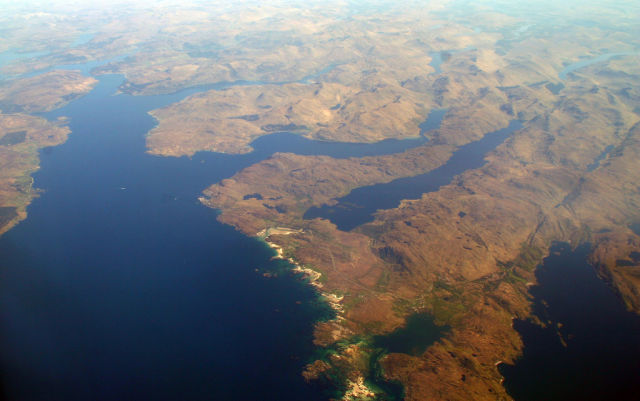
Image: Loch Morar

Thursday, 22 December 2011

Morag, the monster of Loch Morar - 1

For our festive blogs, we thought we’d give the red water charms a little rest and turn to quite another phenomenon altogether. Alexander Carmichael probably spent only a couple of days in the district of Morar, in the heart of the rugged Garbh Chrìochan or Rough Bounds of the western Highlands. Among the items he recorded there is some fascinating material concerning the mysterious ‘monster’ of Loch Morar.


Writing to Father Allan Macdonald of Eriskay on 9 September 1902, Alexander Carmichael describes how recently ‘I was in Canna, Eigg, Skye, Morar, Arasaig, and Lochaber. I have much to tell you but must defer.’ He had already been recording in the Hebrides since the middle of June. Carmichael goes on to tell Father Allan how he had returned home to Edinburgh with his daughter Ella the previous Friday – that is, the 5 September.

This letter, then, gives us a likely year for the recordings Carmichael made in Morar. In Carmina Gadelica iii we have a (suspiciously) lengthy Ùrnaigh Mhadainn or Morning Prayer taken down from Mary Gillies there on ‘1 September 190-‘ [CG iii, 40–7]. Carmichael’s 1902 expedition would tally perfectly with this date. It was probably on the same trip that Mary Maclellan née MacDonald, Beòraid, gave him a Moladh Moire or Praise of Mary [CG iii, 126–33: again, perhaps untrustworthily long as it is printed], while Ann Maclellan, crofter, Mallaig Mhór, gave a prayer to be recited on first glimpsing the new moon, A’ Ghealach Ùr [CG iii, 288–9].

This blog, however, is devoted to material the collector appears to have recorded from a Eòghan Dùghallach. Although the name Eòghan is often translated as Hugh, a couple of references in local census records available online might suggest that in English Carmichael’s informant was called Ewan MacDougall. In one text Carmichael describes him as living in Mallaig Bheag, while in another he is from Beòraid Bheag: the latter is named as his home village in an anecdote printed in CG iv, 230–1. This particular story tells of how Mary Macmillan from Sgiathairigh on the shores of Loch Hourn relieved MacDougall’s brother of a very painful fish-scale in his eye by using Eòlas a’ Chaimein or the Charm of the Mote, and how the folklorist made an epic journey to her remote village to try to record the charm from a descendant, Mary Cameron. Although ‘a pleasant and hospitable woman’:

on no account would she repeat to me ‘Eòlas a’ Chaimein’, though I tried every possible means to persuade her. She said that the ‘eòlas’ was entrusted to her for no foolish purpose, and she was not going to impart it for any foolish purpose to any person.

Alexander Carmichael had to return to Edinburgh empty-handed.

There are three separate texts in Carmichael’s manuscript collection about Mòrag, the mysterious creature which supposedly inhabits the depths of Loch Morar. As noted, it looks as if Eòghan Dùghallach was the principal source for his information. Judging from style and handwriting, it looks as if there are two earlier items and a later one. One is a series of notes, probably transcribed some time after the original recording:

Morag

Morag is always seen before a death and before a drowning especially before the death of the proprietor.
When Iain Ruadh was drowned she was seen by Coll MacColl a native of Tiree. She was seen about six years ago before a man was drowned.
Eoghan Dughallach saw the Morag several times in his long life.
The Morag came to a man in Gleann Loch an aineach [i.e. Gleann an Lochain Eanaiche] and spoke to him. [CW493 fo.35]

The second text is more expansive:

A’ Mhòrag / Mòrag

Tha creatair ann an Loch Morar agus is e a Mhorag / Morag a theirear rithe – There is a creature in Lochmorar and she is called Morag. She is never seen save when one of the daoine duchasach – of the hereditary people of the place dies. The last time she was seen was when Aonas na Traigh, Aeneas Macdonnell, died in 1898 (?).
  The Morag is peculiar to Loch Morar. She is seen in broad daylight and by many persons – including church persons – parsons. [note in margin: She has been seen by the narrator Eoghan Dughallach and by many others including pearsachan eaglais.]
  She appears in a cnap dubh – a black heap or ball slowing and deliberately rising in the water and moving along like a boat water logged.
  The Morag is much disliked and is called by many uncomplimentary terms – Morag dhubh – black Morag – morally not physically – Morag Odhar – dun Morag. Morag dhuibhre – dusky Morag. Morag Ghran[n]da – ugly Morag. As sure as Morag is seen as surely a ‘duchasach’ [above: heredient] dies immediately thereafter. She is not seen when one of the common people dies but is always seen when one of the duchasaich – heredients – dies – One of the native chiefs or relatives of one of the native chiefs. The last time Morag was seen was immediately before the death of Aongas na Traigh – Aonas of Traigh – in 1898.
  Eoghan Dughallach Beoraid bheag – Beoraid Mhic Shimi – firmly believed in the Morag and gave many vivid descriptions of its appearance and occurrence. [CW493 fos.38–9]

Any further information from local historians or genealogists about the people mentioned in Carmichael’s accounts would be very much appreciated. In our next blog we shall take a look at a third text concerning ‘the Morag’.

References: CW493 fos. 35, 38–9.
Elizabeth Montgomery Campbell with David Solomon, The Search for Morag (London: Tom Stacey, 1972).
Alasdair Roberts, Tales of the Morar Highlands (Edinburgh: Birlinn, 2006), 122–33.

Image: A lovely photograph of Loch Morar from the blog ‘The Adventures of Murpharoo’.

Sunday, 18 December 2011

Wee Charmers - 1

Over the past week a number of emails have arrived in the Carmichael Watson inbox with the rather alarming heading ‘urine charms’. The reason for the sudden spate of interest (to coin a phrase) is a series of threads on the online discussion group Old-Irish-L investigating three Old Irish charms in the illuminated manuscript known as the Stowe Missal. We thought it might be of interest to trace charms for what probably were similar ailments, as gathered by Alexander Carmichael when he was living in Uist between 1864 and 1882. The following blogs, then, will offer you all you’ll ever need (or probably want) to know about the mysterious world of red water charms.

The primary purpose of these charms is to cure cattle of a disease usually referred to in the islands as bun-dearg. The term is obscure, but if it derives from ‘bùrn dearg’, it is directly related to its English equivalent, ‘red water’. Although nowadays ‘red water disease’ refers to a serious and often potentially lethal ailment caused by the parasite Clostridium hemolyticum in the kidneys, in Carmichael’s late nineteenth-century Hebridean world the term would have been applied to any potentially lethal disease in which one of the principal symptoms was red urine. In a society where wealth was calculated by the numbers of cows owned, the loss of a single beast could have catastrophic effects, especially on poorer households. Here is Alexander Carmichael’s folk explanation of the bun-dearg in his ‘vocabulary notes’ at the end of the second volume of Carmina Gadelica:

Bun-dearg, red swelling; ‘burn dearg,’  red water; ‘galar dearg,’ red disease; ‘earna dhearg,’ ‘ earnach dhearg,’ red murrain; ‘earna dhubh,’ ‘earnach dhubh,’ black murrain. The red and the black murrain are two stages of this disease, which is produced by several causes. On the mainland it is generally caused by the cattle eating the young leaves of shrubs and trees, especially the bog myrtle, the alder, and the birch, and by drinking water impregnated with them. In the Isles the disease is caused chiefly by eating the sundew (drosera rotundofolia). Wherever sundew prevails red pleura is common. A place in South Uist is known as ‘Bogach na fala,’ marsh of blood, from the prevalence of sundew and its deadly effects. (CG ii, 238)

We’ll return to this account later on.

The first of Carmichael’s red water charms was gathered from Ann MacIsaac née Maclellan (c. 1808–1883), Ceann Langabhat, an t-Ìochdar, South Uist. Ann was the daughter of John Maclellan, farmer in Bòrnais, and his wife Christian Macmillan; she was probably from the same stock as the celebrated storyteller Angus MacLellan (1879–1949) from Loch Aoineort. In 1847 Ann married Hector MacIsaac, one of the principal seanchaidhean or storytellers in South Uist. Hector’s stories were first recorded by Hector Maclean in 1859 as part of John Francis Campbell’s Popular Tales of the West Highlands project. Alexander Carmichael clearly hit it off with the couple; perhaps they even regarded the young bachelor as the son they never had.

As we shall see in a later blog, Ann MacIsaac may have been the first person from whom Alexander Carmichael recorded charms and incantations, the genre with which he would go on to make his reputation in the first two volumes of Carmina Gadelica, published in 1900. Among the six charms she apparently gave to him on 16 October 1867 was Eòlas a’ Bhun-deirg, the Red Water Charm. Here is his later transcription:

Muir mor eas ruadh,
Ruith eir d’ fhual
Stad eir d’ fhuil.

Great sea, red cascade,
May your urine flow,
May your blood stop.

Note: this is thrice repeated over the sick animal afflicted with ‘Red water’. [CW87 fo.18v]

Liquid imagery of sea, river, and waterfall, together with commands to flow or stop, are probably universal in all European charms concerning blood and urine, whether they’re intended against red water or for staunching wounds.

There was, however, one major problem with Ann MacIsaac's charm for Alexander Carmichael when he was compiling and creating Carmina Gadelica. It was far too short to be printed as a stand-alone item. In a subsequent blog we shall take a look at what might have been his solution. 

Wednesday, 7 December 2011

The Laird of Coll's Powder Horn

As the Carmichael Watson Project moves into a new, Leverhulme Trust-funded phase, we’re starting to investigate Alexander Carmichael’s fascinating personal collection of objects, now looked after in the West Highland Museum in Fort William. One particularly interesting item may be connected with an unusual waulking song Carmichael recorded in Mingulay.

As discussed in a blog earlier this year, Alexander Carmichael ‘discovered’ waulking songs while on a visit to the little island of Mingulay/Miughalaigh, at the southern tip of the Outer Hebrides, on 8 August 1867. Carmichael was back in Mingulay on 22 May 1869, doing intensive song-recording from his friend Roderick MacNeil (c. 1790–1875), Ruairidh an Rùma, as well as from two local women, Mary MacDonald (c. 1837–1915) and someone he later describes as ‘Mary wife of Angus Campbell’. We’ve been unable to trace her, but there’s a possibility Carmichael might have meant Marion (b. c. 1841), wife of John Campbell, who appears on the island in the 1871 census. The two women sang their songs to the very appreciative collector not at the waulking board, but while woolworking – ‘one carding, the other spinning’ – one singing the lines and the other the chorus.]

Among the songs Carmichael recorded is one with the following impassioned lines:

Mo cheist eir ti[gh]earna Cholla
S trua[gh] nach ann duit bha mi torrach
Luc[hd] mo dha chich liont am bhrollach
Ga nach beirinn dhuit ach torran
Bhi[th] gun chliu as gun char gun cholan[n]
Ach da shuil os cionn mala.
Sa leana[bh] beag na lai[gh] air a chulao[bh]
Sann daga sann aoraic [adharc] fhudair [CW150/24]

My love the Laird of Coll
A shame that I wasn’t pregnant for you
The load of my two breasts full in my chest
Even though I’d only give you a little heap
Without fame, strength, or body,
Just two eyes above a brow.
And the little baby lying behind him
[?With] the pistol and the ‘aoraic fhudair’.

Given the feelings they express, it’s hardly surprising that these lines don’t appear to have been given to any other song collector. But what’s the ‘aoraic fhudair’ in the last line?

The context gives the game away: it’s what would be written in standard Gaelic ‘adharc fhùdair’, a powder horn made out of cow horn, an object used to carry gunpowder without any danger of sparks or soaking. The heyday of the often elaborately decorated powder horn was the eighteenth century, the era of muskets, before the advent of the powder cartridge. By Carmichael’s time the powder horn was quite obsolete apart from occasional use in full ceremonial Highland dress – definitely not a common sight in the Outer Hebrides! It’s hardly surprising, then, that there are few if any other mentions of an ‘adharc fhùdair’ in the corpus of Gaelic waulking songs.

We originally thought that the word ‘aoraic’ which Carmichael wrote down meant that either he or the singer didn’t understand the reference to ‘adharc’ or horn. A brief chat with Professor Donald Meek from Tiree, however, put us right. Across much of the Scottish Gàidhealtachd, ‘adharachd’ is a perfectly acceptable dialect alternative to ‘adharc’. Maybe this is how Carmichael heard it when he was writing it down, or maybe the word was preserved like that in the song, testimony to its Argyllshire origins.

What of the item in Carmichael’s collection? As you’ll have guessed, it’s a powder horn, one of four he acquired. This one is said to have ‘belonged to MacLean of Coll’ – that is, the Laird of Coll, Tighearna Cholla. But did it really? Alexander Carmichael certainly visited the Island of Coll in September 1887, and knew a number of people with Coll connections, so the provenance of our powder horn may be genuine.

On the other hand, might this be a sly joke by the original donor, perhaps in reply to Carmichael’s question, ‘Who owned it?’ The object was a powder horn, an ‘adharc fhùdair’ (or an ‘adharachd fhùdair’). There was a waulking song praising the Laird of Coll where his powder horn is mentioned. ‘So it must have belonged to Tighearna Cholla.’ The story of the powder horn and the waulking song may demonstrate how closely bound up oral tradition and material culture might be. On the other hand, this may just be yet another example of a scholar making too much out of very slender connections. There may be a much simpler explanation lurking somewhere still in Alexander Carmichael’s archive!

Reference: CW150/24
 
Image: A not very clear picture of Carmichael’s powder horn

Monday, 28 November 2011

Oot an' Aboot

It's been a busy few weeks for the team as Phase 4 fever takes holds. The objects which we are cataloguing and researching are held either by The West Highland Museum (WHM), in Fort William or by the National Museum of Scotland (NMS) a few minutes up the road from the office, all of which means we've had to go oot an' aboot.

Two weeks ago, we'd a very productive afternoon with Pam Babes, Collections Development Manager and Angus Kneale, Collections System Manager at NMS looking at their cataloguing system and talking about the best approach for listing Carmichael's objects. We also got a better idea of the material we'll be dealing with there, most of which is tartan and the oddest of which is crossopus fodiens - a water shrew.


Next on the list was a trip to meet Màiri Mooney, curator at The West Highland Museum and to clap eyes on the considerably larger number of items in their Carmichael collection. The weather was hardly kind as we stepped off the train into ankle-deep puddles and driving rain but the welcome was very warm when we arrived at the museum. Many objects from the collection were out on display anyway, so we were able to start matching them to our list, which was originally drawn up to value the collection in the late 40s. What an array of artefacts! Everything from fossils to Jacobite clothing to charms to domestic tools and of course brooches. Many, many brooches. Màiri took a great deal of time with us and let us have the run of the museum for the day, so that we could plan for our next visit. High on our agenda is photographing the items - the current list has around 250 objects, so the task is a considerable one. Personal favourites from the objects we were able to see were a targe, a riding cape and knotted wool for Eòlas Snàithle [Charm of the Threads]. Seeing unfamiliar objects which have been mentioned in now very familiar manuscripts was an enlivening experience altogether.

On my own way home I took a detour to visit the project's friends at Comann Eachdraidh Lios Mòr. I mention this simply to allow me to post a picture showing how beautiful it was on the Tuesday morning!


Reference: Carmina Gadelica, vol. IV (Edinburgh, 1941) pp. 166-167.
Image 1:  Kirsty M Stewart, Màiri Mooney and Domhnall Uilleam Stiùbhart at West Highland Museum.
Image 2: Looking towards Ben Nevis from the north end of Lismore.

Monday, 31 October 2011

Divination on Latha Samhna

Oidhche Challainn or Hogmanay tended to be an occasion celebrated by groups of boys. Hallowe’en (Oidhche Shamhna) and All Saints’ Day (Latha Samhna) were rather different: in the words of Margaret Fay Shaw writing about her time in Gleann Dail/Glendale in South Uist, ‘a night of much jollity, when the house was invaded by visitors in the ugliest disguises they could contrive of sheepskin and unravelled rope.’ It was also, as she goes on to remark, a time for ‘the foretelling the future of sweethearts’, not just in the Hebrides but throughout Scotland, Ireland, and far beyond. Here are Alexander Carmichael’s later transcriptions and expansions of notes on these calendar customs, originally recorded in CW111/15. The stories were probably been jotted down from Gilleasba’ Domhnallach or Archibald MacDonald (c. 1829–1922), a griasaiche or shoemaker in North Uist on 20 November 1873; they precede the items given in a previous blog.

Gilleasbaig, whose first name was mistranscribed by Carmichael as Alexander in Carmina Gadelica ii, 376, lived in Port nan Long or Newtonferry, where his father Donald had been ferryman. With his wife Margaret or Peggy (b. c. 1841) he had three children: Catherine Margaret (b. 1868); Donald (b. 1870); and Angus (b. 1875). When Carmichael visited the family in 1873 they were probably sharing the house with Gilleasbaig’s unmarried sister Mary (b. c. 1823), his apprentice Archibald Munro from Harris (b. c. 1851), and a local servant Christy MacDonald (b. c. 1846). By the time of the 1891 census Gilleasbaig was a widower, living alone with his daughter Catherine. Rather unusually for a man of his age, he is recorded as being able to speak English as well as Gaelic; this, and the knowledge he would have acquired from his trade of the people in the surrounding townships, may have been the reason why he was in charge of the local Post Office. We might wonder, however, just how strong Gilleasbaig’s grasp of English really was: ten years later, with all three of his children back living with him in what must have been a relatively substantial house, he appears as speaking Gaelic only. A picture of a refurbished Newton Post Office, Gilleasbaig's home, taken by Alasdair Alpin MacGregor, is printed on p. 144 of Bill Lawson's North Uist in History and Legend (Edinburgh: John Donald, 2004).

Gilleasbaig Domhnallach died of influenza on 25 February 1922. Only a neighbour was present, who gave his deceased wife’s name as Catherine MacDonald née Stewart: evidently it was known that his daughter Catherine Margaret had been named after his wife, but the wrong name was given. Born c. 1829, Gilleasbaig is a very unusual example of an informant who was born before Alexander Carmichael and outlived him – and, we can be sure, almost all of his contemporaries.

La Samhna Goid a chail [All Hallows’ Day, stealing the cabbage]. Girls put cal under the pillow. If a girl sees her lover talking the cal from under her pillow she is to be married to him that year. Three plates, one of earth, one of salt, and one of clean water are placed on the floor. A girl is blindfolded and the plates are moved about. The girl is then led to the plates, into one of which she places her hand – each place indicating something, as the uir, earth, death; the salt (bitterness) diolanas [illegitimacy]; and the clean water, marriage!

The girls then throw their criosans, belts, out through the opened window. A blindfolded person throws them back one by one each girl picking up her own crios as it came in. The position in point of trim of the belt in the ceremony indicated the position in point of the time of the owner’s marriage. If no belt could be found no marriage.

[in left margin: See Burns] The girls went to Allt criche a mach stream, when they dipped their hands. They were not to speak till spoken to in their sleep and the speaker then was their lover.

Tilgeil Ghloinneachain [Throwing Glasses]

Clear water was put into a glass. The white of an egg – gealagan uibhe – was gently let down. If the white rose craobhach briagh [beautiful like a tree] it was fortunate; if not, the reverse. Salt, drowning; dirty water meant Diolanas. A craobh chorc, an oat tree-stalk, was drawn out of a stack by the teeth. The number of grains remaining indicated the number of children. If the top grain – ‘graine mullaich’ –was off, the person died.

Reference: CW7/31
Image: Port nan Long in the fifties: Gilleasbaig Domhnallach may have lived in one of the derelict blackhouses on the right.

Tuesday, 25 October 2011

Another Glimpse of the Professional Weeper

Alexander Carmichael’s Carmina Gadelica is one of the principal sources for information about the bean-tuiream: the mourning woman or professional weeper. An account has already been published in this blog for 30 January 2011, in which a quote is taken from CG ii, 309. There Carmichael reminisces about how, in 1870, he had ‘prevailed upon a woman in Barra to do the “tuiream” as she had heard it when young.’

More information about this intriguing episode is preserved in papers in CW383, apparently the text of a lecture given by Carmichael, probably in the 1890s. The keener is revealed to be none other than Catherine Pearson or MacPherson (c. 1813–1880), wife of Alexander MacFarlane, Ceann Tangabhal, Barra. Despite a reputation for witchcraft, Catherine, together with her brother John (c. 1820–1885), was clearly one of Carmichael’s favourite informants in the island. We hope to have more anecdotes about Catherine in subsequent blogs. The text below has been lightly edited for legibility:

The old custom of mourning, called in Scottish Gaelic tuireadh, in Irish caoineadh, ceased in the Highlands many years ago. Upon one occasion, however, the writer had the privilege of being present at a funeral in Barra where a woman was prevailed upon [supra: very unwillingly] to reproduce this lost art. [del: The woman is now dead but the writer sees her still before him. Her name] [supra: She was called] Catherine Phearsan.

She is now dead but the writer sees her still before him with her [supra: tall] spare figure which [supra: in youth] must have been once singularly handsome, her good prominent features, her fine, large blue eyes, silvery hair, and voice of great flexibility and compass, and [supra: her copious] [del: a] command over the Gaelic language, truly marvellous.

She was richly endowed by nature but not by art, mentally and physically.

This woman rehearsed in weird, [?] and measured cadences of great attraction to my untutored ear the deceased man’s kindly deeds and manly actions by sea and land, his kindreds for generations back, his relationship to long lineaged proud chiefs, ‘and fair women and brave men’. She pathetically told too of the prostration of the fair young wife with her swan-like bosom thus laid bare to the weary wintry blasts and of the tender nestlings thus bereft of a loving father whose brave heart, strong arm and deft hands was wont to bring them home the white ling from the angry sea, the brown barley from the laboured field, the juicy cockles from the distant strands and the good puffin from the towering cliff. The bare glaciated hill high overhead re-echoed the woman’s voice, whilst the deep rolling restless, heaving sea underneath our feet seemed to moan as if in sympathy.

We buried the man in Brendan’s lovely burying-place near the base of an amphitheatre of hills benignly looking down and surrounded on three sides by the sea. The glorious Atlantic sings requiem to the dead in a voice, now louder than loud thunder wakening terror in the trembling earth, and now softly sighing with an eerie sugh like the hallo[w]ed tones of dying love.

Carmichael certainly recorded Catherine or Catriona Pearson on 21 June 1870 (if indeed the year given in Carmina Gadelica is correct). He visited her brother John on 2 December and, perhaps, 2 June. We know he was on Barra on 30 September, 6 November, and the 1 December as well. We wonder if any of our readers could help us in working out who might be the crofter-fisherman of Castlebay, with widow and young children, who was mourned by her?

Reference: CW383 fos.11–13

Image: The burial ground at Gob Bhuirgh, Barra

Stone whorls WHM 1992 13 2.4

Stone whorls WHM 1992 13 2.4
Stone whorls collected by Alexander Carmichael, held by West Highland Museum (ref. WHM 1992 13 2.4). [© carstenflieger.com]