Showing posts with label charms. Show all posts

Tuesday, 19 February 2013

Innovative Learning Week 2013

Image


Innovative Learning Week at the University of Edinburgh is a week-long programme of learning events that provides students with an exciting opportunity to learn in a creative and informal way.  
ILW2013 aims to encourage undergraduate and postgraduate students to:

  • gain a new perspective on your degree subject
  • learn new skills
  • think about a future career
  • exchange ideas and stimulate debate
  • meet staff and students from different Schools and Colleges
  • network and find new opportunities for research or revision

Domhnall Uilleam and Guinevere from the Carmichael Watson Project prepared a workshop about the charms in the Carmichael Collections. Drawing on both the archive here at the Centre for Research Collections and the object collection at the West Highland Museum, the workshop discussed both the verbal charms and the amulets.  

The session began by outlining the various shapes and sizes a charm can take from a stone to a brooch to an incantation. The term charm is so loose that it can be applied to a wide range of objects that were believed to generate protective, curative, attractive or maleficent power.


Carmichael, over the span of his folklore career, recorded around 60 charms and considering the privacy and personal aspect surrounding charms this is quite a substantial and pertinent collection.  These charms can be found in Carmina Gadelica and in his notebooks that are available on the project's online catalogue, and there are charms for all sorts of problems from toothache to broken bones! There are some recorded verbal charms that were collected in the 1960s and 70s accessible via Tobar an Dualchais: Eòlas an Dèididh, Chanadh neach an rann seo trì uairean, Tha am fiosraiche ag aithris seun.


Carmichael also collected charm objects that were used throughout the islands. A number of these objects have been highlighted in previous blogs such as the whorls, flint arrowheads and sea-beans. There was also a mention of the use of domestic and agrestic tools doubling up as divination devices, namely the winnowing riddle that was used to predict a future spouse! 


The workshop finished up with a discussion about the use of charms today, and the decline in their use, and superstitions. One participant shared a belief from Southern Florida with the group: when a cat passes in front of a car, a cross must be marked on the windshield to prevent bad luck! 

It was a really enjoyable session with a good discussion and we'd like to thank those who came along. 

A review of the session is available to read on the Innovative Learning Week 2013 blog: click here.

Image
Copyright Carsten Flieger 

Tuesday, 22 May 2012

Carmichael and herbal remedies

Mary Beith, author of Healing Threads; Traditional Medicines of the Highlands and Islands, sadly passed away last week. Her book is a comprehensive overview traditional medicine from charms to remedies and a great source of information. Today's blog highlights some of the various plants used for cures (human and animal), charms and enchantments in Carmichael's collection.
St John's Wort
Bog myrtle / Roid: good for worms. CW120/76

Burdock / Searan: used with horns [croic nam fiadh] to treat consumption.
CW89/203

Dog-carmillion / Braonan nan con: can be taken like tea as a cure for flux. CW117/55

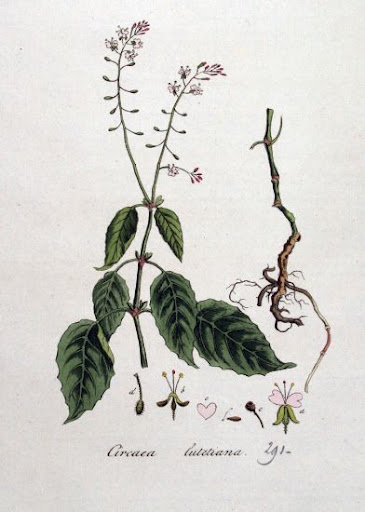
Enchanter’s Nightshade /Lus an Tàlaidh: was administered to a lover without his knowledge, in order to entice him. CGvi, 102

Figword / Lus an torranain: was used for medicinal properties on the mainland, it was applied to cuts, bruises, sores and tumours. And on the islands it was used for its magical powers, primarily to ensure milk in the cows. CGii, 78

Fionn-faoilteach: 'is pulled and carried to the ceart court and which ensures victory'.
CW108/89

Golden Saxifrage / Lus nan Laogh: used to cure syphilis. CW120/303

Ivy: used in a charm with a rod, hoop, broken horseshoe nails and linen to protect cows and their milk. CW7/27
Enchanter's Nightshade
Juniper berries: are 'successful for epilepsy'. CW117/158

Marsh Chickweed / Fliodh Moire: the plant is heated on a flat stone facing the fire; a person with a festering hand or foot places the hand or foot on the stone and the heated plant over the sore. CGvi, 75

Oat-tree stalk / Craobh-chorc : can be used to tell fortunes about the number of children one will have. CW7/31

Pearlwort / Mòthan: used to protect the milk of cows. CGvi, 110

Sloes: wine made from sloes was a cure for diarrhoea. CW111/66

Spearwort / Lus Mòr: is good for blistering, lumbago and rheumatism. CGvi, 102

St John’s Wort / Achlasan Chaluim-Chille: was used to both ward away evil and promote prosperity and peace. The plant was only effective when accidentally found. CGii, 96

Yarrow / An Earr Thalmhainn: If when you go out in the morning the flowers are closed then your lover will spurn you and if not, then she will accept you. Also, if the petals are falling then you will not find the person or animal you are looking for. CW87/24

When you're out and about taking photos for Carmichael's centenary on 6 June, why not see if you can identify any the plants named above!
 
References
http://www.carmichaelwatson.lib.ed.ac.uk/
Carmichael, Alexander Carmina Gadelica, vol. II (Edinburgh, 1941)
Carmichael, Alexander Carmina Gadelica, vol. VI (Edinburgh, 1941)

Images
St John's Wort from wildseed.co.uk
Enchanter's Nighshade from luirig.altervista.org

Tuesday, 13 March 2012

Prayers, blessings, charms, and incantations: What Carmichael did and didn't print before Carmina Gadelica - II

In this blog and the next one we’d like to take a look at how Alexander Carmichael was first inspired to publish charms he had collected, in the ‘Nether-Lochaber’ column of the Inverness Courier, compiled by his friend the Rev. Alexander Stewart (1829–1901).

Stewart was always looking for fresh material for his newspaper column, a compendium of local anecdotes and observations, mainly concerning natural history and folklore, whose lively conversational style and curious subject matter had won a wide readership throughout the country. For many readers, ‘Nether-Lochaber’ was the Inverness Courier. Among the myriad topics broached by Stewart were proverbs, riddles, songs, and charms: short, unusual items which could fill a column and were almost guaranteed to elicit a response from readers, encouraging them to send in examples of their own.

From September 1871 ‘Nether-Lochaber’ began to mine a productive lode, printing a series of Gaelic riddles and other linguistic curiosities together with English translations. Among them was a healing charm, ‘taken down for us a short time ago by a gentleman in a neighbouring district from the recitation of an old woman on his property. It bears internal evidence of being intended for use only in the case of sprains, bruises, and dislocations.’ This was printed, together with a translation, in the Inverness Courier for 9 November 1871:

Esan a mharcaich gu stòld’,
Air an asail dheas òg a bha grinn;
A leighis gach creuchd ’s gach plàigh,
’S a dh-aisig gu slaint’ na bha tinn;
Leighis E sùilean an doill,
Do’n bhacach rinn rathad réidh;
Le Peadair ’s le Pàl, ’s le Muire bean àigh,
Biodh dlu an drasd’, a leigh[e]as nan cnamh ’s nam féith’.
Suathadh a’s sile a’s luibh Challam-chille
   (’An ainm an Athair),
Suathadh a’s sile a’s luibh Challam-chille
   (’An ainm a Mhic),
Suathadh a’s sile a’s luibh Challam-chille
   (’An ainm an Spioraid Naoimh),
Suathadh a’s sile a’s pòg ’o bhilibh –
      Amen!

He that rode with dignity
On the fine young ass that was handsome;
Who healed every wound and plague,
And restored the sick to health;
He healed the blind man’s eyes,
And made a level path for the crippled man;
With Peter and Paul, with Mary, blessed woman,
May [He] be near now, to heal the bones and sinews.
Rubbing and spittle and Saint Columba’s wort
   (In the name of the Father),
Rubbing and spittle and Saint Columba’s wort
   (In the name of the Son),
Rubbing and spittle and Saint Columba’s wort
   (In the name of the Holy Ghost),
Rubbing and spittle and a kiss from the lips –
      Amen!

On 20 June 1872, after the interest in riddles had run its course, Stewart published another four charms, including the two taken from Caraid nan Gàidheal. These were Rann Galar nan Sùl (‘A Rhyme for Sore Eyes’); Eòlas air a’ Ghréim-Mhionaich (‘A Charm for the Colic’); Eòlas an t-Snìomh (‘A Charm for a Sprain’); and Eòlas an Tairbhein (‘A Charm for the Tairbhean’). One reader in particular was inspired by the column to send in some charms from his own collection: Alexander Carmichael.

References:
‘Nether-Lochaber’, Inverness Courier, 9 November 1871 & 20 June 1872.

Image:
Rev. Alexander Stewart, ‘Nether-Lochaber’, Celtic Monthly, ix (1901), 19.

Wednesday, 7 March 2012

Prayers, blessings, charms, and incantations: What Carmichael did and didn't print before Carmina Gadelica

From his papers we can calculate that during the time he lived in Uist, between 1864 and 1882, Alexander Carmichael recorded at least 62 charm texts. But in actual fact, Carmichael would print hardly any of this rich corpus under his own name before he published the first two volumes of Carmina Gadelica in 1900. What did appear was a number of prayers and blessings among other ‘old hymns’ included in ‘Grazing and Agrestic Customs of the Outer Hebrides’, Carmichael’s unorthodox contribution to Appendix A of the Napier Commission’s Report into the Condition of the Crofters and Cottars in the Highlands and Islands of Scotland (1884), 451–82; these were republished in Lord Archibald Campbell’s Records of Argyll (Edinburgh: William Blackwood & Sons, 1885), 385–98. Some of these appeared again in the paper Carmichael gave on 24 December 188 about ‘Uist Old Hymns’ to the Gaelic Society of Glasgow, a revised version of a newspaper report of which was printed in the Society’s Transactions, i (1887–91), 34–47.

Now, it seems significant that neither of these pieces, ‘Grazing and Agrestic Customs’ or ‘Uist Old Hymns’, actually contains any item whatsoever which Carmichael would include in the second volume of Carmina Gadelica, the one mostly taken up with Uibe or Incantations. What we do have in these articles are what he was to describe in the first volume of CG as Achaine or Invocations: that is, blessings and prayers. This inevitably brings us to the delicate and problematic distinction between blessings and prayers, and charms and incantations. The Gaelic scholar Alexander Macbain, whom we’ll meet again shortly, anticipates a common, but by no means uncontroversial, modern definition of the latter when he writes:

An incantation consists of a formula of words which is recited to bring about certain physical results to which the meaning of the words has some correspondence more or less direct. [Alexander Macbain, ‘Gaelic incantations’, Transactions of the Gaelic Society of Inverness, xvii (1890–1), 222].

But strict, watertight divisions between the two genres are difficult to uphold. Macbain admits as such a few pages later on:

The exact line of demarcation on the one hand between what is an incantation and what is a prayer or hymn, and on the other hand between an incantation and an ordinary secular song, is often difficult to draw. [ibid., 230]

We can build on Macbain’s suggestion by suggesting that, pragmatically and in general, it was felt that charms tended to focus upon specific ailments or accidents, to ‘bespell’ people, or to protect them against evil eye. Of course prayers could also function to protect or cure; charms, however, often needed to be recited by a specific class of people to be efficacious: the luchd-eòlais, or ‘cunning folk’ in English. Charms were usually more ‘performance pieces’ than prayers, often delivered with the assistance of an object or an amulet, in specific places, at specific times, and under specific conditions of enactment. Most importantly of all, charms had to be kept secret. Often a charm couldn’t be given to just anybody. If it were to retain its efficacy, it had to be handed down under certain restrictions: a woman had to give a charm text to a man or vice versa, for example. Once the charm had been given to somebody else, the original reciter might lose their power to use it. Prayers, on the other hand, were much more portable, and much more public.

In both ‘Grazing and Agrestic Customs’ and ‘Uist Old Hymns’, it’s notable that Carmichael never uses the words ‘charm’ or ‘incantation’. We have ‘hymns’, ‘prayers’, ‘invocations’, ‘croons’, and ‘dedicatory hymns’, but no charms. If anything, Carmichael appears keen to play down the category: although he reprints six pieces from the Napier Commission Report in ‘Uist Old Hymns’, it may be significant that this time he misses out the Beannachadh Buachailleachd (‘Herding Blessing’) and the Rann Buachailleachd (‘Herding Rune’), prayers to protect cows which to our eyes shade suspiciously into charms to be recited by milkmaids and cattle herds. Mention is certainly made in ‘Uist Old Hymns’ of a Eòlas Ceartais, but this piece is described as a prayer rather than a charm for justice, and is not printed in the article. Incidentally, this was probably the Eòlas Ceartais obtained from Catrìona Macintosh, Staoidhligearraidh, on 20 May 1875 (CW87/17 [fos.12v–13]), and printed as Ora Ceartais, no. 20 in CG i, 52–3.

Two questions for the next blog on this subject: Which charms recorded by Alexander Carmichael had been published before Carmina? And why was he apparently so reluctant to see them in print once more?

References:
Alexander Carmichael, ‘Grazing and Agrestic Customs of the Outer Hebrides’, Parliamentary Report into the Condition of the Crofters and Cottars in the Highlands and Islands of Scotland (1884), 451–82.
_____. ‘Prayers and hymns of the Hebrides’ in Lord Archibald Campbell (ed.), Records of Argyll (Edinburgh: William Blackwood & Sons, 1885), 385–98.
_____. ‘Uist old hymns’, Transactions of the Gaelic Society of Glasgow, i (1887–91), 34–47.
Alexander Macbain, ‘Gaelic incantations’, Transactions of the Gaelic Society of Inverness, xvii (1890–1), 222–66.

Images:
Staoiligearraidh, home of Catriona Macintosh

Thursday, 1 March 2012

Tracking Down Treasures

Last Sunday the team made their way through beautifully snowy glens to Fort William to carry out a significant piece of work for the project. Fort William is home to the West Highland Museum, where the majority of the artefacts collected by Alexander Carmichael are held. Indeed, the museum has looked after the collection for a long time, first taking it in as a loan from Michael Carmichael, one of Alexander's grandsons, in 1948 before it was gifted to the museum in 1992.

Domhnall Uilleam placing a winnowing riddle for Carsten to photograph


In addition to research, this phase of the project aims to catalogue all the objects collected by Carmichael. In order to make a useful online catalogue photographs are required, so we hired Highland photographer Carsten Flieger to work with us. Now, the collection is complicated enough, with Uist plaids, Jacobite tartans, bronze brooches, bone pins, fossils, wool carders, sea bean charms, oil lamps and swords to contend with without adding in the fact that a large proportion of the collection is on display. Luckily for us museum volunteer and former curator Sally Archibald had given up her time to help us identify objects in storage and carefully remove and replace objects on display. No mean feat given the weight of some of the display cases - it's not just the tango that takes two.

Guinevere proving the worth of a porridge breakfast with the charms display case


The variety of objects, their dispersal throughout the museum and the need to consult different lists compiled over the years made the task quite complicated, however we soon had a production line of sorts going. Working from the largest objects to the smallest, prioritising items on display and trying to keep things made of similar materials together were key. Over the five days we were in Fort William, of the 200 or so items which were produced Carsten took over 300 photographs. What we've seen so far is first-class and we can hardly wait to see them all properly: ruddy-red tartans, shiny sea beans, ferocious flax combs. However, we're going to have to wait as we still have some objects to to photograph, which, now we have some experience, we know will probably take another two days.

Carsten and the bright lights making sure everything looks as it should

We are grateful to the West Highland Museum, especially manager Colleen Foggo for letting us work for as long as possible each day to get through the material and for being patient with us as we roved the different floors and rooms of the museum seeking out Carmichael-collected objects. We are indebted to Sally Archibald for the extraordinary energy and work she put into locating and identifying items.

Sally and Kirsty try to identify a brooch

The museum re-opens following its winter closure next week, so if you're in Fort William, do go in as it's well worth the time.

Stone whorls WHM 1992 13 2.4

Stone whorls WHM 1992 13 2.4
Stone whorls collected by Alexander Carmichael, held by West Highland Museum (ref. WHM 1992 13 2.4). [© carstenflieger.com]