Tuesday, 22 May 2012

Carmichael and herbal remedies

Mary Beith, author of Healing Threads; Traditional Medicines of the Highlands and Islands, sadly passed away last week. Her book is a comprehensive overview traditional medicine from charms to remedies and a great source of information. Today's blog highlights some of the various plants used for cures (human and animal), charms and enchantments in Carmichael's collection.
St John's Wort
Bog myrtle / Roid: good for worms. CW120/76

Burdock / Searan: used with horns [croic nam fiadh] to treat consumption.
CW89/203

Dog-carmillion / Braonan nan con: can be taken like tea as a cure for flux. CW117/55

Enchanter’s Nightshade /Lus an Tàlaidh: was administered to a lover without his knowledge, in order to entice him. CGvi, 102

Figword / Lus an torranain: was used for medicinal properties on the mainland, it was applied to cuts, bruises, sores and tumours. And on the islands it was used for its magical powers, primarily to ensure milk in the cows. CGii, 78

Fionn-faoilteach: 'is pulled and carried to the ceart court and which ensures victory'.
CW108/89

Golden Saxifrage / Lus nan Laogh: used to cure syphilis. CW120/303

Ivy: used in a charm with a rod, hoop, broken horseshoe nails and linen to protect cows and their milk. CW7/27
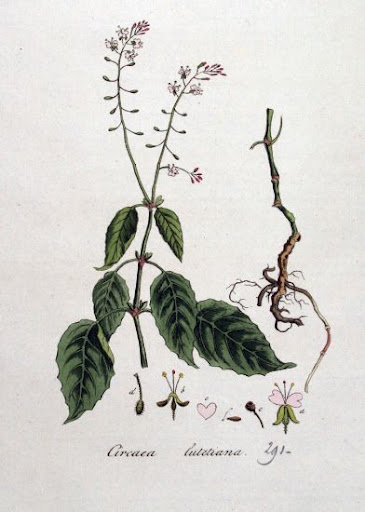
Enchanter's Nightshade
Juniper berries: are 'successful for epilepsy'. CW117/158

Marsh Chickweed / Fliodh Moire: the plant is heated on a flat stone facing the fire; a person with a festering hand or foot places the hand or foot on the stone and the heated plant over the sore. CGvi, 75

Oat-tree stalk / Craobh-chorc : can be used to tell fortunes about the number of children one will have. CW7/31

Pearlwort / Mòthan: used to protect the milk of cows. CGvi, 110

Sloes: wine made from sloes was a cure for diarrhoea. CW111/66

Spearwort / Lus Mòr: is good for blistering, lumbago and rheumatism. CGvi, 102

St John’s Wort / Achlasan Chaluim-Chille: was used to both ward away evil and promote prosperity and peace. The plant was only effective when accidentally found. CGii, 96

Yarrow / An Earr Thalmhainn: If when you go out in the morning the flowers are closed then your lover will spurn you and if not, then she will accept you. Also, if the petals are falling then you will not find the person or animal you are looking for. CW87/24

When you're out and about taking photos for Carmichael's centenary on 6 June, why not see if you can identify any the plants named above!
 
References
http://www.carmichaelwatson.lib.ed.ac.uk/
Carmichael, Alexander Carmina Gadelica, vol. II (Edinburgh, 1941)
Carmichael, Alexander Carmina Gadelica, vol. VI (Edinburgh, 1941)

Images
St John's Wort from wildseed.co.uk
Enchanter's Nighshade from luirig.altervista.org

Wednesday, 16 May 2012

Commemorating Carmichael's Centenary

Friends and followers, on Wednesday 6 June, we would like you to help us mark 100 years since Alexander Carmichael passed away by picking up your camera. During his lifetime, Alexander Carmichael not only travelled to many places to collect folklore but he also lived in many places and we would like to create a photographic record of each of his abodes. So, your mission, should you choose to accept it, is to help us take these photos.


View Commemorating Carmichael's Centenary in a larger map

We’ve listed below all the known addresses in chronological order, some are imprecise and some no longer exist, in which case a photograph of the vicinity or an appropriate local landmark would suffice. If you or someone you know are in or near one of these places on or around 6 June, take a photo and send it to us by e-mail, facebook or twitter and we’ll put them together. It’d be terrific if we could get at least one picture of every place listed to remember a man whose work and influence spread far and wide.

1832 Born Taylochan, Isle of Lismore

1841 Kilean, Isle of Lismore

1851 Kilandrist, Isle of Lismore

Early 1850s At high school, Greenock
1858-1859 Ayr

1859-1860 Dublin [Second Division of Excise]

1860-1860 Bridgend, Islay

1860-1862 Talisker Farm, Isle of Skye

1862-1864 The Cottage, Trevance, St Issey, Cornwall [working at the Excise in Wadebridge]

1864-1871 Lochmaddy, North Uist

1868 Married at 3 Wardie Avenue, Edinburgh

1871-1871 Truimeasgearraidh Manse, North Uist

1871-1872 Ìochdar, South Uist

1872-1878 The Bungalow, Creagorry, Benbecula

1878-1879 Duncreagan, Oban

1879-1880 6 Strathavon Terrace, Oban

1880-1882 Scolpaig Farm House, North Uist

1882-1883 30 Royal Circus, Edinburgh

1883-1889 31 Raeburn Place, Edinburgh

1884 On holiday at Bay Cottage, Taynuilt

1889-1893 29 Raeburn Place, Edinburgh

1893-1899 7 St Bernard’s Row, Edinburgh

1899-1900 Airds Bay Cottage, Taynuilt

1900-1905 32 Polwarth Gardens, Edinburgh

1905-1906 28 Viewforth, Edinburgh

1906-1912 15 Barnton Terrace, Edinburgh

1912 Buried St Moluag’s, Isle of Lismore

2012 Time to get snapping!

E-mail: carmichael.watson@ed.ac.uk

Facebook: http://www.facebook.com/CarmichaelWatsonProject

Twitter: @Coll97CW

Map of all the Edinburgh locations

Sources
Some of the addresses have been found in Carmichael's papers [Coll-97 CW] while others have been derived from County and Street Directories, many of which are available online.

Tuesday, 8 May 2012

A Place-Name Weekend in Oban

The Scottish Place-Name Society conference at Oban last weekend was a real pleasure to attend: the town was looking its best in the early summer sun, there was an excellent selection of papers, and, to round things off, we had a fascinating trip out and about in the surrounding countryside of Muckairn and Glen Lonan, in which Alexander Carmichael recorded so much during the 1880s and 1890s.

My paper, on the local folklore collections made by Carmichael and the Rev. Niel Campbell (1850–1904), Church of Scotland minister of Kilchrenan and Dalavich, dovetailed nicely with the one given by Brigadier John MacFarlane. Drawing upon voluminous papers compiled by his family in Taynuilt over several generations, about history, folklore, songs, poetry, and place-names, John offered a precious glimpse into a time, not that long ago, when Muckairn was an overwhelmingly Gaelic-speaking parish. Today, there’s only himself left of the seann seòid. Ach nach math gu bheil ur leithid ann!

Denis Rixson, well known as historian of the Rough Bounds and Small Isles, offered us a rigorous wrestle with the fascinating and controversial question concerning the meaning and extent of traditional land valuation assessment units such as merklands, pennylands, ceathramhan, davachs, and more, throughout the western Gàidhealtachd. A fundamental problem was summed up in his astute comment that there is absolutely no guarantee that the extent of farms and townlands remained static throughout the centuries. (If we factor in recent historical findings concerning the nature and influence of environmental changes and population mobility and variablity over the centuries, the challenge of synthesising medieval land assessments with later documentary evidence might be even trickier than we had hitherto imagined.)

Michael Hance of the Scots Language Centre explored contemporary usages and manifestations of Lowland Scots in place-names and toponymy, making the perhaps unanswerable point that if we have, for instance, Linlithgow and Gleann Iucha on a public sign, should there not be a place for Lithgae too?

Professor Carole Hough of Glasgow University gave an exciting overview of the new AHRC-funded Scottish Toponymy in Transition project there. Having nearly finished the Place-Names of Fife, the project is on a roll. The next focus for the team is Clackmannanshire and Kinross-shire, with additional research planned on Cunninghame (North Ayrshire), Berwickshire, and Menteith, subject of Peter McNiven’s recent excellent PhD thesis.

One personal highlight was the bus trip next day around Muckairn and Glen Lonan, led by John MacFarlane. It was intriguing to see the beautifully picturesque but perhaps less epic reality behind the heroic landscape summoned up by Alexander Carmichael, a world of Ossianic champions, clan strife and legend, battles prophesied or in the past, a cradle of great men such as Iain Lom, and the supposed homeland of the ancestors of Robert Burns and John Ruskin.

As one extra bonus, I was able to spend Sunday afternoon in the newly-opened 1745 House at Dunollie Castle, poring over the MacDougall Papers. This exceptionally important archive, together with the frankly amazing Hope MacDougall Collection (undoubtedly to feature in blogs to come), should make visits to Dunollie compulsory for all those with an interest in the people, history, and culture of the western Highlands.


John MacFarlane talking the group through the site of the Battle of Daileag, fought between the MacDougalls of Dunollie and incoming Campbells.


‘Daileag was an ideal field of battle in the time of days of hand to hand encounters…’ [CW504 fo.35v] Cruachan Beann in the background: ‘’S iomadh linn bhon d’fhuair iad còir/Air a’ bheinn is bòidhch’ r’a faicinn.’


Airds Bay – the cottage where the Carmichaels lived from 1899 to 1901 is on the left-hand side behind the trees. 'Deagh Choimhead' in the background.


A sheila-na-gig in her latest home in the walls of the most recent Taynuilt parish church.


Dùn Tamhnachan/Duntanachan, where the Rev. Archibald Clerk (1813–87) of Kilmallie was brought up.


Clach Dhiarmaid at Tòrr an Tuirc. In the foreground, so legend avers, the enclosure in which the Ossianic hero was laid to rest.

Thanks to everyone involved in the Scottish Place-Name Society conference, especially Dr Jake King who organised the conference - and also to Catherine Gillies, Project Manager at Dunollie Castle.

Wednesday, 2 May 2012

A Day in the North Harris Hills


Here is Alexander Carmichael enjoying what must have been a rather short and maybe wintry day out in the hills of North Harris with John MacLeod of Tolmachan, Miabhag nam Beann.

North Harris

Stron Ard North Harris Friday 18th Nov 1881

John Macleod son of Finlay Macleod Gamekeeper Tolmachan Miabhag nam Beann with me. He knows the name of every place all over North Harris.
   Cave under projecting rock. Wall built across projecting rock at mouth of cave. Cave looking down Gleann Miabhaig and over to Lews moors and mountains. Just under Stron Ard the wall is built to join the projecting rock on the top.
   Another cave about 100 yards S.W. of this with all running under projecting rock. The wall of this cave is ?sided in ruins.
   At Stron an Sguirt see a pair of eagles hovering over a small drove of ‘[?dus-grithich] agus daimh[’]. At foot of rock there are numbers of /ptarmigans/tarmachain running among the moraghan – moraghan beinne – shingle moraghan beinne – mountain shingle to distinguish this shingle from moraghan mara sea shingles. The ptarmigans are called gealag bheinn – mountain grilse mountain whiteling – from white winter snow plumage. The bird has a peculiar plaintive hoarse call or cry as if trying to expel something from its throat. I heard ‘tarmachain’ about half a mile about away from me. They rose in three flocks of 15, 25, and 35. They were in a transition state between their summer and winter plumage. The birds rose on the wing each flock following the other and went downhill and out of sight upon a lower level saw a small flock of six gorcocks red grouse moving about and then a baidne ghobhar – a flock of goats scrambling among the rocks and precipices and mountain screes.
   Down in Loch Sguirt saw salmon leaping high up in the air and then falling down in the water with a splash – sometimes the splash made a great noise probably when the fish came down upon his side upon the surface of the water.
   Sometimes the otter is seen chasing the salmon – an interesting sight. The salmon more likely the grilse – gealag mhara – sea-white trout, banag mhara sea-white trout flies through the water now and then rising in the air and coming down with a splash. All in vain however. The dobhar donn – brown otter gains upon the grilse and makes a meal of it.
   If there be a stone standing in the lake or in the river the otter goes to it with his prize and eats the fish sitting or standing upon the stone. While eating the fish the otter closes his eyes and sees nothing and hears nothing. This is the time to have a shot at the otter if within reach.

D’uair ’s e ’n ron is cu ’s an ruaig
Cha teid gearr a chuain as. / gearr=grilse

When the otter [actually seal!] is the hound in the chase
The hare of the ocean cannot escape.

Ullabhall is full of the ‘gealag bheinne’, while Loch Ullabhall is full of ‘gealag mhara’.
   There are no tormachain on Stron an Scuirt, Tormachan probably from torm, toirm, murmur.

Reference: CW217 fos.109–11

Image: Gleann Mhiabhaig agus Sròn Sgùirt – image by Tom Richardson at geograph.org.uk

Tuesday, 1 May 2012

Beltane: May Day


The first of May is one of the quarter-days in the Celtic calendar and marks the beginning of a new season. Beltane is the most celebrated of the four days as it represents the start of summer, a busy and fruitful time for farmers.


The day is closely associated with fire as a source of purification. Last year’s blog outlined the tradition of the need-fire and how both people and cattle walked through it for purification and protection. The fire was thought to safeguard the animals against witches who were believed to be very active and powerful at Beltane. Similarly to Samhainn, the barrier between this world and the supernatural was weakened on this day and extra caution was taken to protect the farm animals. The animals had tar placed behind their ears or on the tip of their tails to keep away any evil. Often flowers, juniper and rowan were used as protective barriers as well.

 Bonfire

It was believed to be extremely unlucky to start a fire in your own home on May Day or to let a fire be taken from the house. It was thought that whoever took fire from the house would have control over the milk produced by the lender’s cattle.


A popular game amongst the young adults was to make a cake of oatmeal with one part daubed in black, place the cake in a hat and then do a lucky dip. The person who picked out the blackened piece had to jump through the fire three times.

In Ireland May Day traditions are still quite popular, especially bonfires and gathering flowers. There is a piseog or superstition that if you loan anything on May Day it will never come back to you. One of the most popular traditions, associated with England, is dancing around the Maypole.

In the CW notebooks there is a brief note concerning Beltane: La Bealtain light fires.


References
CW 111/13, fo. 4v.
Rev. John Gregorson Campbell (ed. Ronald Black), The Gaelic Otherworld (Edinburgh: Birlinn, 2006), 552-554.
Image
http://edenhills.wordpress.com/2010/07/14/may-1-beltane-01may2010/

Monday, 23 April 2012

Museum Ethnographers Group Conference 2012

The Museum Ethnographers Group was established in 1975 and their aim is to promote an understanding of museum ethnography. Membership is not restricted to museum curators; anyone with an interest in ethnography can join and be kept up-to-date via the newsletter, twitter and website.

Last week the MEG’s annual conference was held in the National Museums of Scotland, Edinburgh. This two day affair was an exciting opportunity for the team to meet up with museum folk from all over the UK and gain insight into the world of museums. The location itself was ideal (just a stone’s throw from the library!) with NMS looking inspiring after the refurbishment.

This year’s theme was 'Multiple Dialogues: interpreting ethnographic collections in the 21st century' which was of particular interest to us and Carmichael’s material collection. It was fascinating to hear the speakers and learn of the various methods for presenting and interpreting collections from all over the world. A speaker from Zeeuws Museum in the Netherlands, Caroline van Santen, spoke about a Blackfoot exhibit and how she worked closely with Clifford Crane, a Blackfoot Indian, in order to gain a greater understanding of the objects in the collection. Catherine Moore from the Powell-Cotton Museum in Kent spoke about how she worked with the Angolan community in preparation for a forthcoming exhibit ‘TALA! - Visions of Angola’.

Another interpretation of the theme was the museums’ youth programs. A number of speakers discussed their thriving programs and upcoming exhibits as chosen by the young curators (14-24 years old). Two of these young curators co-presented a talk about their exhibit entitled ‘The Curious Case of the …’ a play on the Victorian cabinet of curiosities. These programs allow them to organise the exhibit from choosing the objects, researching the selected objects, labeling, presenting and designing the leaflets. These opportunities only made me wish I was ten years younger!

The conference was a great event and it offered us a new perspective on Carmichael’s collection housed at both the West Highland Museum and the National Museums of Scotland, Edinburgh.

A brooch from the Carmichael Collection, West Highland Museum


Links
MEG
West Highland Museum
NMS

Wednesday, 11 April 2012

A Trip to the Well

A common topic discussed in folklore from all over the world is the well as a sacred site. The tradition of pilgrimage to wells is still practised although not as widespread as it was in the past. In 1581 the practice was actively frowned upon in Scotland and the result was an Act of Parliament ‘against passing in pilgrimage to chapels, wells and crosses, and the superstitious observing of diverse other popish rights’. This Act set out to put the public on the straight and narrow as pilgrimages were thought to be misguided beliefs rather than evil practices. In later years the Church essentially absorbed some of the practices into their doctrine.

The process of the pilgrimage was quite a rigorous procedure for those who were desperate for results. The following is a list of key elements that were adhered to in Scotland:

• The trip to the well was done at a very specific time whether a time of day or a day of the year. The day of year coincided with the patron saint of the well, for example, pilgrimages in honour of Moluag take place on 25th June. The most popular times of day for the pilgrimages were sunrise and sunset.

• The ritual of the pilgrimage required a circumambulation deisil (clockwise) around the sacred site; this was commonly repeated three times in the name of the Father, the Son and the Holy Ghost and it was believed to enclose the sacred space.

• Silence was observed with the exception of prayers or incantations at the well.

• Tokens such as pins, coins, shells, and buttons were left at the well as a sacrifice. There are records of more substantial sacrifices being made for example Hector Mackenzie was recorded in the presbytery of Dingwall 1678 for sacrificing a bull on Inis Maree to Saint Maelrubha hoping to cure his wife.

• At clootie wells a piece of cloth from the patient’s clothes was taken and pinned to a nearby tree or bush. It was believed that the disease would be transferred from the patient to the cloth.

• For those who were unable to travel water would be taken from the well and conveyed to them. It was very important that neither water nor container touched the ground on this journey and the water was called uisge sèimh. Carmichael explains why it is so called in Carmina Gadelica iv: “The person who draws the water must observe silence from the time of setting out to the time of returning from the well, whence the name ‘uisge sèimh”. In the notebooks Carmichael notes that water was taken from Tobar Chriosd, Vatersay for this purpose.

For a more detailed account see Aude Le Borgne's Clootie wells and water-kelpies: an ethnological approach to the fresh water traditions of sacred wells and supernatural horses in Scotland (Unpublished PhD thesis, University of Edinburgh: 2002).

In the next blog entry we will examine more unusual practices associated with wells and saints.

References
Beith, Mary Healing Threads: Traditional Medicines of the Highlands and Islands (Edinburgh: Polygon, 1995)
Carmichael, Alexander Carmina Gadelica, vol. IV (Edinburgh, 1941) p. 132.
CW107/11 fo. 21
Le Borgne, Aude. Clootie wells and water-kelpies: an ethnological approach to the fresh water traditions of sacred wells and supernatural horses in Scotland (Unpublished PhD thesis, University of Edinburgh: 2002)
http://rps.ac.uk/

Stone whorls WHM 1992 13 2.4

Stone whorls WHM 1992 13 2.4
Stone whorls collected by Alexander Carmichael, held by West Highland Museum (ref. WHM 1992 13 2.4). [© carstenflieger.com]