Showing posts with label cures. Show all posts

Friday, 3 August 2012

Objects in Focus: Snuff Mulls


 ©Carsten Flieger
In the Carmichael Collection housed at the West Highland Museum, Fort William there are a number of snuff mulls. These were made from various materials: horn, bone, ivory, wood, stone, sea-beans (the larger entada gigas) and were used to carry snuff. The mulls in the photographs are all made from horn. 
 ©Carsten Flieger
Snuff was extremely popular in Scotland during the 17th and 18th centuries, and was used by both men and women, rich and poor. The photographs show the traditional conical style with a lid (unfortunately only one lid) and the other style was a barrel-shaped container. These snuff mulls were for personal use and could be carried around in your pocket but they were gradually replaced by boxes. There were larger mulls that were used communally, and these often had wheels on the base to pass them easily around the table. A ram's head with both horns was popular for table mulls and occasionally the hoof of a horse would be used! 
 ©Carsten Flieger
The snuff mulls came in all shapes and sizes but the most popular were made from a ram's horn and maintained the curl. In the photo below the decoration is quite striking, a bird's head with a precious stone for the eye and, on top there is silver plating with AD 1792 inscribed. The lids were used to keep the container as airtight as possible as tobacco dries up very easily when exposed to air.  

 ©Carsten Flieger
So what exactly is snuff? It is a pulverised tobacco that is insufflated, or snuffed, through the nose. There were two main methods for taking the snuff, outlined here by D.F.N. Harrison: Some will transfer a pinch direct from snuff-box to nostril, while others use a silver spoon to convey it from the back of the hand to the nostril. 
 ©Carsten Flieger
It was commonly believed that snuff was great for curing certain ailments, particularly for diseases of the head (toothache, decongestion, bad breath). In CW110/2 there is a great example of the 'curative power' of snuff:

Cure – A crofter woman in Cnoc an torrain was winnowing bere on the knoll when a grain of bere went in her ear. Her friend tried to extract the grain of bere from the womans ear but failed. Part of the awn was still attached to the spiligean and after its manner its always pushed forward. The ear became inflamed and the woman was suffering much She noticed the Dotair Ban (Dr Alexander Macleod passing and she ran out to meet him and described her condition. He put a large dose of snuff on his dearna – palm and requested her to sniff it all up. She did so while he took a firm hold of her nostrils. She sniffed and  sniffed and sniffed again and at last threw the grain of bere out some five feet away.

Snuff was so closely linked with Scotland that in England a wooden effigy of a Scotsman in full Highland dress was often found outside tobacco shops!

References
CW110/2

Harrison, D.F.N. 'Snuff: Its Use And Abuse', The British Medical Journal , 2:5425 (1964), pp. 1649-1651
Images
Carsten Flieger

Tuesday, 22 May 2012

Carmichael and herbal remedies

Mary Beith, author of Healing Threads; Traditional Medicines of the Highlands and Islands, sadly passed away last week. Her book is a comprehensive overview traditional medicine from charms to remedies and a great source of information. Today's blog highlights some of the various plants used for cures (human and animal), charms and enchantments in Carmichael's collection.
St John's Wort
Bog myrtle / Roid: good for worms. CW120/76

Burdock / Searan: used with horns [croic nam fiadh] to treat consumption.
CW89/203

Dog-carmillion / Braonan nan con: can be taken like tea as a cure for flux. CW117/55

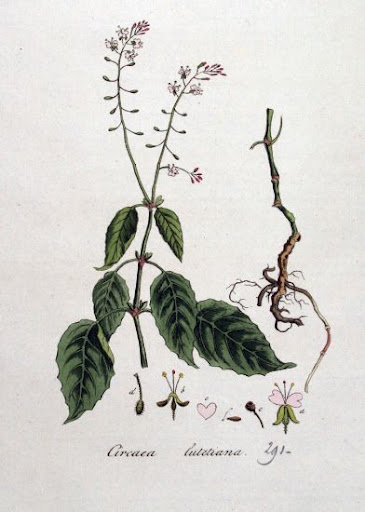
Enchanter’s Nightshade /Lus an Tàlaidh: was administered to a lover without his knowledge, in order to entice him. CGvi, 102

Figword / Lus an torranain: was used for medicinal properties on the mainland, it was applied to cuts, bruises, sores and tumours. And on the islands it was used for its magical powers, primarily to ensure milk in the cows. CGii, 78

Fionn-faoilteach: 'is pulled and carried to the ceart court and which ensures victory'.
CW108/89

Golden Saxifrage / Lus nan Laogh: used to cure syphilis. CW120/303

Ivy: used in a charm with a rod, hoop, broken horseshoe nails and linen to protect cows and their milk. CW7/27
Enchanter's Nightshade
Juniper berries: are 'successful for epilepsy'. CW117/158

Marsh Chickweed / Fliodh Moire: the plant is heated on a flat stone facing the fire; a person with a festering hand or foot places the hand or foot on the stone and the heated plant over the sore. CGvi, 75

Oat-tree stalk / Craobh-chorc : can be used to tell fortunes about the number of children one will have. CW7/31

Pearlwort / Mòthan: used to protect the milk of cows. CGvi, 110

Sloes: wine made from sloes was a cure for diarrhoea. CW111/66

Spearwort / Lus Mòr: is good for blistering, lumbago and rheumatism. CGvi, 102

St John’s Wort / Achlasan Chaluim-Chille: was used to both ward away evil and promote prosperity and peace. The plant was only effective when accidentally found. CGii, 96

Yarrow / An Earr Thalmhainn: If when you go out in the morning the flowers are closed then your lover will spurn you and if not, then she will accept you. Also, if the petals are falling then you will not find the person or animal you are looking for. CW87/24

When you're out and about taking photos for Carmichael's centenary on 6 June, why not see if you can identify any the plants named above!
 
References
http://www.carmichaelwatson.lib.ed.ac.uk/
Carmichael, Alexander Carmina Gadelica, vol. II (Edinburgh, 1941)
Carmichael, Alexander Carmina Gadelica, vol. VI (Edinburgh, 1941)

Images
St John's Wort from wildseed.co.uk
Enchanter's Nighshade from luirig.altervista.org

Stone whorls WHM 1992 13 2.4

Stone whorls WHM 1992 13 2.4
Stone whorls collected by Alexander Carmichael, held by West Highland Museum (ref. WHM 1992 13 2.4). [© carstenflieger.com]