Thursday, 23 May 2013

Luibh bheag bheag, luibh bheannaichte / A small small plant, a blessed plant


There are numerous accounts of plant lore noted in Carmina Gadelica and within the notebooks at the Centre for Research Collections, and a previous blog highlighted some of the key plants for popular herbal remedies. This blog notes some uses for am mothan / pearlwort including a method for securing a spouse!

The 'mothan' (bog violet?) is one of the most prized plants in the occult science of the people. It is used in promoting and conserving the happiness of the people, in securing love, in ensuring life, in bringing good, and in warding away evil.

When the 'mothan' is used as a love-philtre, the woman who gives it goes upon her left knee and plucks nine roots of the plant and knots them together, forming them into a 'cuach' - ring. The woman places the ring in the mouth of the girl for whom it is made, in the name of the King of the sun, and of the moon, and of the starts, and in name of the Holy Three. When the girl meets her lover or a man whom she loves and whose love she desires to secure, she puts the ring in her mouth. And should the man kiss the girl while the 'mothan' is in her mouth he becomes henceforth her bondsman, bound to her everlastingly in cords infinitely finer than the gossamer net of the spider, and infinitely stronger than the adamant chain of the giant.

The 'mothan' is placed under parturient women to ensure delivery, and it is carried by wayfarers to safeguard them on journeys. It is sewn by women in their bodice, and by men in their vest under the left arm.
 
An old woman in Benbecula said: - 'thug mi am mothan beannaichte do Ruaraidh ruadh mac Roaghail Leothasaich as a Cheann-a-deas agus e air a thuras do Loch-nam-madadh, dol ga fhiachain air bialabh an t-siorram agus fhuair e dheth ge do bha e co ciontach 's a chionta ri mac peachaich' - 'I gave the blessed 'mothan' to red Roderick son of Ranald of Lewis from the South-end (of Uist), and he on his journey to Lochmaddy to be tried before the sheriff, and he got off although he was as guilty of the guilt as the son of a sinner.'  'Ach a Chairistine carson a thug sibh am mothan dh'an duine agus fios agaibh gun robh e ciontach? Saoilidh mi fein nach robh e ceart dhuibh a dhol ga dheanamh' - 'But, Christina, why did you give the 'mothan' to the man when you knew that he was guilty? I think myself it was not right of you to go and do it!'  'O bhidh 's aodaich! a ghraidhean mo chridhe agus a ghaoilean mo dhaoine, cha b' urra dhomh fhein dhol ga dhiultadh. Bhoinich e orm, agus bhochain e orm, agus bhoidich e orm, agus chuir e rud am laimh, agus O! a Righ na gile 's na greine, agus nan corracha ceuta, curra, de b' urra dhomh ghein a gh' radh no dheanamh agus an duine dona na dhubh-eigin na dhear-theinn agus na chruaidh-chas' - 'O food and clothing! thou dear one of my heart, and thou loved one of my people, I could not myself go and refuse him. He beseeched to me, and he swelled to me, and he vowed to me, and he placed a thing in my hand, and oh! King of the moon, and of the sun, and of the beautiful, sublime stars, what could I myself say or do, and the bad man in his black trouble, in his red difficulty, and in his hard plight!' I remembered Bacon and was silent.

To drink the milk of an animal that ate the 'mothan; ensures immunity from harm. If a man makes a miraculous escape it is said of him. 'Dh' ol e bainne na bo ba a dh' ith am motha ' - 'He drank the milk of the guileless cow that ate the "mothan"'. 


Buainidh mi am mothan ,                                                             Pluck will I the ‘mothan,’
Luibh nan naodh alt,                                                                      Plant of the nine joints,
Buainidh agus boinichidh,                                                           Pluck will I and vow me,
Do Bhride bhorr 's dh' a Dalt.                                                      To noble Bride and her Fosterling.

Buainidh mi am mothan,                                                              Pluck will I the ‘mothan,’
A dh’ orduich Righ nam feart,                                                     As ordained of the King of power,
Buainidh agus boinichidh,                                                           Pluck will I and vow me,
Do Mhoire mhor ‘s dh’ a Mhac.                                                   To great Mary and her Son.

Buainidh mi am mothan,                                                              Pluck will I the ‘mothan,’
A dh’ orduich Righ nan dul,                                                         As ordained of the King of life,
Bheir buaidh air gach foirneart,                                                 To overcome all oppression,
Is ob air obi shul.                                                                               And the spell of evil eye. 

Laomachan. 'Little mouldy one', was a rind of cheese used for divination. The cheese must be made on one of the four old festivals of the year: Bealltain, Beltane; Lùnasd, Lùnasdal or Lùnasdain, Lammas; Samhain, Hallowtide; and Fèille Brighde, the Feast of Brigit; but on which of these is now uncertain. The milk used was that of a cow which had eaten the mòthan, pearlwort, for since the plant was sained the cheese was sained also. twelve months after the cheese was made it was used. A small hole was made through the rind, and through this the diviner looked down through the fàrlas, smoke-vent of the house. The name of the first person thus seen through these two orifices was the name of the future spouse. When the loamachan was placed under the pillow, the sleeper would in dreams see his future spouse coming towards him with gifts; were the person seen receding, it indicated a parting. the laomachan safeguarded its wearer from the wiles of the fairies of the mound, from the venom of the hosts of the air, and from the misleading light of the teine mòr or teine sionn, will o' the wisp. For naming, for dreaming and for safeguarding, the laomachan was effective only on the anniversary of the fesitval on which it was made, and only to those who had faith and sincerity of heart; only to those who bowed to them were the names true. Many curious rites and ceremonies connected with the laomachan and its use are now but dimly to be descried through the darkness of ages. 

References
Carmina Gadelica ii, 110-113.
Carmina Gadelica vi, 94-95.
 Image
© Carl Farmer   

Wednesday, 1 May 2013

Beltane Bannocks

Beltane is an important day in the Celtic calendar that marks the beginning of summer, and the day is still widely celebrated. Fire was, and is, used as a method of purification and the various practices were outlined in previous May day blog entries (anseo agus anseo).

In Carmina Gadelica there is a note about quarter cakes, bannocks that were smaller than the St Michael's strùan, but it is apparent that the tradition was no longer widespread in the late 19th century.

Throughout the Highlands and Islands special cakes were made on the first day of the quarter. As in the case of the 'struan', a large cake was made for the family and smaller cakes for individual members. So far as can now be ascertained, these cakes were round in form. They were named after their dedications. That baked for the first day of spring was called 'bonnach Bride,' bannock of Bride; that for the first day of summer, 'bonnach Bealltain,' Beltane bannock; that for the first day of autumn, 'bonnach Lunastain,' Lammas bannock; and for the first day of winter, 'bonnach Samhthain,' Hallowtide bannock. The names of the individual cakes were rendered into diminutives to distinguish them from the family cake, while the sex of the person for whom they were intended was indicated by the termination, as 'Bridean,' masculine diminutive, 'Brideag,' feminine diminutive, after Bride; 'Bealltan,' 'Bealltag' after Beltane; 'Luinean,' 'Luineag' after Lammas; and 'Samhnan,' 'Samhnag' after Hallowmas. The people repaired to the fields, glens, and corries to eat their quarter cakes. When eating them, they threw a piece over each shoulder alternately, saying: 'Here to thee, wolf, spare my sheep; there to thee, fox, spare my lambs; here to thee, eagle, spare my goats; there to thee, raven, spare my kids; here to thee, marten, spare my fowls; there to thee, harrier, spare my chickens.'
Baking bannocks over an open fire

In a contribution to Folklore 1895 is a note about Beltane bannocks, and variations on the tradition are noticeable. One description reads as follows:


Bannocks were baked the evening before Beltane, the first day of May (O.S.), and were called Beltane bannocks. They were made of oatmeal in the usual way, but they were washed over or "watered" with a thin batter composed of whipped egg, milk or cream, and a little oatmeal. Before being laid on the "brannithr" (Keith), "branner" (other districts), :ie. gridiron, the upper side was rubbed over with this batter. When the underside was sufficiently baked or "fired," the bannock was turned, and the underside was now rubbed over with the batter. The bannock was then allowed to hang over the fire on the gridiron till fully baked. 

On Beltane about mid-day the young folks, each with a bannock, went to the rocks or high grounds, and rolled them down. If a bannock broke in the rolling, the one to whom it belonged would come to some disaster or die before next Beltane. They ate them, but left a "bittie" to the "cuack" or cuckoo. They carried a piece home, and placed it under the pillow in the sweetheart's name, to find out if dreams would reveal the future as to marriage. Eggs were not used in baking the Baptismal and Christmas bannocks. 
JANET DAVIDSON (aged 8I), Kingussie. 


A second account of the bannocks:


At Achterneed, near Strathpeffer, Ross-shire, on the first day of May the children received each an egg and a cake. With these they went to the hill, as many at times as twenty and thirty in company. They gathered material, formed a bonfire, and roasted the eggs in the ashes. Before placing the egg in the ashes, each child put a mark on it so as to be able to identify it when taken from the ashes. The egg and the cake were eaten. The cake was baked between nine and ten o'clock in the morning. It was kneaded entirely in the hand, and not on a board or table like common cakes. It was "fired" or baked in front of the peat fire on the hearth supported by a stone. After being so baked it was put into the child's hand, and not on any table or dish. It must never be put from the hand except to be baked in front of the fire. If laid on anything it was then nothing more than an ordinary bannock. It was called "tcharnican" (spelt phonetically), because it was made wholly in the hand. The word means " hand-cake." Those now sent were baked by a native of the parish of Fodderty, who is now eighty-three years of age. One of them was baked in my presence. 
REV. WALTER GREGOR, LL.D. 

Carmichael also notes that traditionally Thursday was considered a lucky day for all enterprises except when Beltane fell on a Thursday:


'D uair is Ciadaoineach an t-Samhain
Is iarganach fir and domhain,
Ach 's meirg is mathair dh' an mhac bhaoth
'D uair is Daorn dh' an Bhealltain.

When the Wednesday is Hallowmas
Restless are the men of the universe;
But woe the mother of the foolish son
When Thursday is the Beltane. 

Better be wary for Beltane 2014!

References
Carmichael, A. Carmina Gadelica i (Edinburgh: Floris Books, 1900-1972) pp. 163.
Carmichael, A. Carmina Gadelica i (Edinburgh: Floris Books, 1900-1972) pp. 208-9. 
Goodrich-Freer, A. 'More Folklore from the Hebrides', Folklore, 13:1, (1902), pp. 29-62. 
Gregor, W., Davidson, J., Robertson, Munro, Maclean, G., Farquharson, J. and Macintosh, H. 'Notes on Beltane Cakes', Folklore, 6:1 (1895), pp. 2-5. 

Image

©National Museums Scotland. Licensor www.scran.ac.uk

Wednesday, 24 April 2013

Preview of the catalogue

This Friday the Carmichael Watson Project object catalogue, based on Carmichael's collections at the West Highland Museum and the National Museums of Scotland, will be going live!

Over the past year the team have been locating, researching, photographing and cataloguing all the objects, and a select few were featured in blog entries. Altogether the collections contain more than 440 objects from the smallest coin to a large carved stone slab.

Here's a hint at what others objects are in the catalogue: 
Carved Stone Slab, National Museums of Scotland

Swatches of tartan cloth, National Museums of  Scotland

Copper Alloy Brooch, West Highland Museum

Silver Luckenbooth Brooch, West Highland Museum

Copper cup, West Highland Museum

Spanish coin and Roman coin, West Highland Museum

Snàithle, West Highland Museum

Basket-hilted sword, West Highland Museum

Silver Ring Brooch, West Highland Museum
Images
NMS objects © National Museums of Scotland
WHM objects  © Carsten Flieger 

Friday, 12 April 2013

Objects in Focus: Stone Font


In the National Museum of Scotland, Edinburgh a handful of objects collected by Carmicahel are on display: a baptismal font, a stone font and a Pictish stone. Carmichael's own notes explain where the stone font was found and the particular curing beliefs associated with it.  
Stone font
The small primitive porous looking font is from Christ's Burying Ground (Cladh Chriost) in the Island of Pabbay, Barra. 

Like the other islands of Barra, Pabbay is extremely rugged and precipitous and except during settled weather inapproachable on account of the Atlantic surf. On the south east side of the island there is an open bay. Behind this surf-beaten bay and in front of this glaciated hill beyond is a semicircular valley the bottom of which on the north side is composed of deep accumulated sand drift. 

This was formerly covered with bent (muran) and other grasses but the surface breaks caused by the winter storms have been inattended to of late years, the winter winds have swept away the sand to a great depth leaving studded over the valley high cone-like mounds as monuments of neglect. Cladh Chriost is one of these cone-like mounds. It is about thirty feet high and composed or built up of many successive and distinctive layers of sand, like so many different pieces of bleached and unbleached cotton on a drapers shelf and pointing to different periods of formation. 

Its base has already become considerably hard and solid thus affording us the late and interesting opportunity of examining the slow and silent yet sure and inevitable process by which Time converts the flying particles of sand into hard and solid rock. Had no fortuitous circumstances prevented this sand mound would be converted into sand stone rock, in which would be embedded at various distances from the surface well preserved human remains, some of them surrounded by rows of carefully selected polished pebbles from the strand, and others by irregularly coarse common moor stones from the hill; innumerable bits of cinerary urns, of different manufactures and evidently of different periods with pins and needles, of bone, bronze and brass.

Stone font
And in the event of these hard memorials of man surviving like the tender lady from the process of petrefaction, perchance some future Hugh Miller might arise in the distant ages to draw therefrom lessons of utility instruction and wisdom.

A stream flows from the scariated hill behind which strikes during spates with considerable force against the rear of Cladh Chriost after which it skirts round the base thereof undermining and carrying in its sacrilegious course, the crumbling mound of sand, human remains, and human memorials, in one confused mass, into the continuous and tumbling, toiling, troubles sea below.

Embedded in the grassy sandy summit of this disused and neglected burying ground, this simple font rested for ages. But having been lost to sight of late, a search was made for it two years ago, at my request which resulted in finding it in the bed of the stream beneath, upon which it was obligingly transmitted to me to Lochmaddy.

This font was for centuries an object of credulous belief to the inhabitants of Pabbay and the other southern Isles of Barra. These simple people implicitly believed that the touch of this font like that of another stone in S. Mary’s burying ground (Cladh Naomh Moire) in the neighbouring island of Bearnaray (Barra-Head) was efficacious in preventing and removing many mental and physical disorders incident to themselves and their flocks. The lixivium found in the font was considered doubly consecrated, firstly through contact with the already consecrated font, and secondly through the friendly agency of some invisible and mysterious power that presided over the scene. The virtues of this salinated water were deemed secondary only to those of the water consecrated by the priest. 

The people rubbed their bodies and their cattle with the font and sprinkled themselves and their flocks with the water contained therein, for the cure of certain bodily ailments and for the prevention of specific acts of witchcraft. And when this ceremony was duly performed with the necessary amount of formality and with the necessary admixture of pagan and christian rites, the people firmly believed that creative spirits of the air, nor the witches of the earth, nor the mermaids of the deep surrounding sea could infuse or molest them. 
Pabbay, Barra
A charm so potent could not be otherwise than an object of deep awe and interest among the hardy, simple and kind hearted people possessing it nor do I doubt but an attempt to remove it eighty or a hundred years ago would have been stoutly resisted and would probably result in serious consequences. But – “Old times are changed, old manners gone, A stranger fills the Stewarts’ throne; The bigots of an iron time, Had called these harmless acts a crime.” 

For a number of years past the belief in the virtues of this charm has been falling into abeyance and now only two old men as far as I know can give an intelligible account of the faded glories of the primitive little font. 

Now, the next time you visit the museum on Chambers Street keep an eye out for this font!

Reference
GB 237 Coll-97 CW457
Images
Font: © National Museums of Scotland
Pabbay: © RCAHMS

Friday, 8 March 2013

Objects in Focus: Targe

Targe, West Highland Museum

The targe, or target [targaid], is a circular wooden shield that was popular in the 17th and 18th century Highlands. It was held with the left arm and a sword, spear or dagger would be carried in the right hand. The targe's primary use was to fend off blows from oncoming attackers, and often the back side was padded to deaden the impact therefore protecting the arm. 

The weapon was constructed from wood boards, typically oak or pine, fastened together and covered with embossed and tooled leather. Brass or nickel studs were added in a circular pattern to the front and a hand grip or two grips were fastened to the back. A common addition was an arm strap to ensure a firm hold on the shield. Occasionally targes were highly ornamented with silver or brass mounts and heraldic representations. 


Targe, West Highland Museum
The targe could likewise serve as a weapon as the centre brass boss, generally the larger boss, could accommodate a spike being attached to it. This was surely a contributing factors to its popularity; the defensive and offensive benefit.

The Highland Charge was a military tactic involving the targe that was successful at battles including Killiecrankie and Prestonpans.  It involved the soldiers discharging their muskets at close range and then charging ahead through the smoke with their targe and broadsword. This tactic was last used at Culloden in 1746 but unfortunately the effect was greatly lessened. Major Mackay Scobie maintained that the soldiers discarded their targes due to their inability, through exhaustion, to carry them.

A Highland Outpost by John Pettie (1839 - 1893)
After Culloden the use of targes went into decline, and the 1746 Act of Proscription  (enforced 1 August 1747) banned the weapon along with all other weapons associated with the Highlands: ‘to have in his or their custody, use, or bear, broad sword or target, poignard, whinger, or durk, side pistol, gun, or other warlike weapon’. This same act restrained the wearing of “Highland Garb”, but was repealed over thirty years later in 1782. A famous quote by Boswell, 1773, reads:

There is hardly a target now to be found in the Highlands. After the disarming act they made them serve as covers to their buttermilk barrels.

This example of a targe is from the late 18th to early 19th century and shows no sign of use in combat which could be due to the lack of hand grip or arm strap on the back. It was possibly made to coincide with the visit of King George IV in August 1822. This visit was orchestrated by Walter Scott who encouraged Scots to wear their tartan proudly for the monumental visit, as a British monarch had not been to Scotland since 1651.

The Carmichael collection at the West Highland Museum has a vast range of objects, a number of which have been presented in blog entries over the past months. The full catalogue of objects is due online via the Carmichael Watson Project website at the end of April 2013.

References
Drummond, J. Highland Targets and Other Shields (Neill and Company, Edinburgh: 1873)
Telfer Dunbar, J. History of Highland Dress (Oliver and Boyd, Edinburgh and London: 1962)

Images
Targe © Carsten Flieger
Portrait: ©Dundee City Council - Arts and Heritage. www.scran.ac.uk

Friday, 1 March 2013

Tartanology


The interest in and debate concerning clan tartans was kick-started by the famous Sobieski Stuart brothers, alleged grandsons of Bonnie Prince Charlie, John Hay Allen [John Sobieski Stolbert Stuart, Count d’Albanie] and Charles Hay Allen [Charles Stuart Hay Allen, Count d’Albanie (succeeding his brother)]. The pair were well known for engaging in all things Highland from wearing the traditional garb to hunting, writing poetry and collecting folklore.

The brothers edited and illustrated the famous Vestiarium Scoticum: from the Manuscript formerly in the Library of Scots College at Douay. With an Introduction and Notes, by John Sobieski Stuart that was published in 1842 by William Tait of Edinburgh. The book lists the clans from all over Scotland: Highlands, Lowlands and the Borders, ‘the order of Terteinis apperteinand unto ye chieff Hieland clannes’ and seventy-five colour plates illustrating the tartans of the clans listed.


Kilt from the Carmichael Collection, West Highland Museum
This impressive publication was based on an ancient manuscript the brothers possessed that was collated with a second manuscript from the library of the Monastery of St Augustine in Cadiz from 1571. Although in 1828 they displayed a 1721 Vestiarium manuscript to Sir Thomas Dick Lauder, this was not used as a source. 

The authority of all these texts was questioned and doubt cast over the brothers' integrity. A popular opinion was that the tartan manufacturers encouraged the publication as the popularity of tartan sky-rocketed from 1842Either way, be it author or editor/illustrator, these two brothers were behind what Telfer Dunbar believed to be ‘probably the most controversial costume book ever written’.

The label reads: Kilt Worn by one of the Sobieski Stuart brothers. Alex Carmichael. 
Carmichael, noted for his extensive collection of folklore, also acquired an extremely significant tartan collection, including a kilt worn by one of the Sobieski brothers. Telfer Dunbar, one of the leading Highland Dress experts, noted:

 “Without doubt the greatest collector of early tartans and dress was Alexander Carmichael – compiler of Carmina Gadelica. His fine specimens of pre-nineteenth-century tartans with their lovely colour combinations and interesting weaves are far removed from the “clan” tartans of later times. Without the work of Alexander Carmichael our knowledge of early specimens of tartan would be very slight indeed.”

The tartan collection, unfortunately, no longer exists as one entity. The West Highland Museum has tartan clothing and NMS, Edinburgh holds some the pre-nineteenth century tartan swatches mentioned above but the rest was scattered after Carmichael’s death. Telfer Dunbar attained a number of samples that the team are eagerly trying to locate!
Jacket worn at Culloden, West Highland Museum
Over the coming months there will be a number of blog entries about this extraordinary facet of Carmichael’s collection. Tartan from the Carmichael Collection is on display in the West Highland Museum that is now open again Mon – Sat, 10 – 4. 

For those readers living in Edinburgh there is a long-term exhibition in the National Portrait Gallery 'Blazing with Crimson: Tartan Portraits'

References
Telfer Dunbar, J. History of Highland Dress (Oliver and Boyd: Edinburgh and London, 1962)
Images
Copyright Carsten Flieger

Tuesday, 19 February 2013

Innovative Learning Week 2013

Image


Innovative Learning Week at the University of Edinburgh is a week-long programme of learning events that provides students with an exciting opportunity to learn in a creative and informal way.  
ILW2013 aims to encourage undergraduate and postgraduate students to:

  • gain a new perspective on your degree subject
  • learn new skills
  • think about a future career
  • exchange ideas and stimulate debate
  • meet staff and students from different Schools and Colleges
  • network and find new opportunities for research or revision

Domhnall Uilleam and Guinevere from the Carmichael Watson Project prepared a workshop about the charms in the Carmichael Collections. Drawing on both the archive here at the Centre for Research Collections and the object collection at the West Highland Museum, the workshop discussed both the verbal charms and the amulets.  

The session began by outlining the various shapes and sizes a charm can take from a stone to a brooch to an incantation. The term charm is so loose that it can be applied to a wide range of objects that were believed to generate protective, curative, attractive or maleficent power.


Carmichael, over the span of his folklore career, recorded around 60 charms and considering the privacy and personal aspect surrounding charms this is quite a substantial and pertinent collection.  These charms can be found in Carmina Gadelica and in his notebooks that are available on the project's online catalogue, and there are charms for all sorts of problems from toothache to broken bones! There are some recorded verbal charms that were collected in the 1960s and 70s accessible via Tobar an Dualchais: Eòlas an Dèididh, Chanadh neach an rann seo trì uairean, Tha am fiosraiche ag aithris seun.


Carmichael also collected charm objects that were used throughout the islands. A number of these objects have been highlighted in previous blogs such as the whorls, flint arrowheads and sea-beans. There was also a mention of the use of domestic and agrestic tools doubling up as divination devices, namely the winnowing riddle that was used to predict a future spouse! 


The workshop finished up with a discussion about the use of charms today, and the decline in their use, and superstitions. One participant shared a belief from Southern Florida with the group: when a cat passes in front of a car, a cross must be marked on the windshield to prevent bad luck! 

It was a really enjoyable session with a good discussion and we'd like to thank those who came along. 

A review of the session is available to read on the Innovative Learning Week 2013 blog: click here.

Image
Copyright Carsten Flieger 

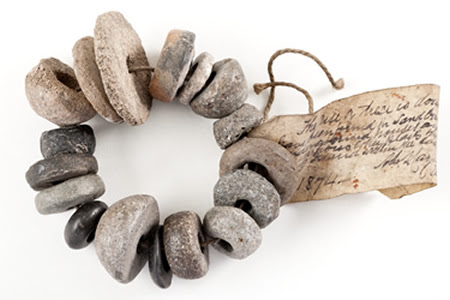
Stone whorls WHM 1992 13 2.4

Stone whorls WHM 1992 13 2.4
Stone whorls collected by Alexander Carmichael, held by West Highland Museum (ref. WHM 1992 13 2.4). [© carstenflieger.com]