Monday, 22 July 2013

Objects in Focus: Querns

Quern stones were popularly used throughout Scotland, to grind and mill cereals, into the twentieth century. A complete rotary quern consists of an upper and lower quern stone that were used simultaneously. Within the Carmichael Collection there are two quern stones, not a pair, that were donated to the Society of Antiquaries of Scotland. Carmichael's notes on one of the quern stones in the collection at the National Museums of Scotland are available to read here
X.BB 24 Upper stone from a granite disc quern

An early form of the tool was the saddle quern and comprised of a large stone to place the grain on and a rubbing stone to do the grinding. The consistent grinding created a characteristic depression on the main stone. The Romans introduced the rotary quern to Britain, This variation of the tool was less labour intensive. These rotary querns stones are disc-shape and the upper stones always has a central hole and either a hollow or smaller hole. To grind down the cereal the grain was fed in through the central hole of the upper quern stone. Rotation was done by hand with a handle that was positioned in a hollow on the upper stone while the lower stone remained stationary.  Grain was crushed between the two stones, pushed to the edge of the stone and caught on a cloth or table under the quern. The result was a mixture of flour, grains and husk that was often processed two or three times to achieve the required fineness.

A hard type of stone, for example granite, was necessary for the quern because the constant grinding would erode softer stone types. The upper face of the top stone is often decorated with concentric grooves and chiselled lines. 
X.BB 25 Rotary quern stone, underside
A definition by Dwelly of the Muileann-brà [quern]:
 
The quern was formerly the only mill for corn-grinding used in the Gàidhealtachd. It is still in use in many parts of northern Europe and in Asia, and the "two women finding at the mill" (quern) may be seen to-day in Nazareth exactly as they were in the days of Christ. The implement consists of two stones, the lower being about two feet in diameter, and commonly hollowed to the depth of about six inches. This hollow is of equal depth and diameter. Within this is placed horizontally, a smooth round flag about four inches thick, and so fitted to the cavity that it can just revolve with ease. Through the centre of this revolving flat there is bored a hole for conveying the grain. In the lower stone, in the centre of its cavity, there is fixed a wooden pin on which the upper stone is placed in such exact equiponderance, that, though there be some friction from their contact, a little force applied will make the upper stone revolve for several times, when there is no grain underneath. On the surface of the upper stone, and near the edge, are two or three holes, just deep enough to hold in its placed the stick by which it is turned round.  The working of the quern is left to the women, two of whom, when the grain is properly dried, sit squatting on the ground, with the quern between them and singing loudly an appropriate song, perform their work, one turning round the stone with the handle placed in one of the holes, and the other dropping the corn in through the large hole. The law of Scotland attempted in vain to discourage the use of the quern. In the year 1248 it was enacted "that no man shall presume to grind quheit, maisloch or rye, with hand mylnes, except he be compelled by storm, and be in lack of mylnes quhilk should grind the samen; and in this case, if a man grinds at hand-mylnes, he shall give the threttein measure as multer; and gif any man contravein this our prohibitions, he sall tyne his hand-mylnes perpetuallie."

X.BB 25 Rotary quern stone, upperside
As noted in the dictionary definition, women performed the task of grinding the grains and sang during the process. In the notebooks there are numerous references to quern-related songs collected by Carmichael: a quern song, a fairy quern song overheard in Berneray and a song collected from Catherine MacFarlane while she was grinding the quern. The fairies are regularly associated with querns and the spindle whorls used in spinning wool were often referred to as fairy querns. 

References
CW90/95
CW120/383
CW150/26 
Dwelly, E. The Illustrated Gaelic-English Dictionary (Glasgow, 1994)
Images
©National Museums Scotland (www.nms.ac.uk)

Wednesday, 19 June 2013

Objects in Focus: Cas-chrom

Cas-chrom
Carmichael's collection contains a vast array of objects including a cas-chrom, a foot-plough, that is on display at the Museum of Rural Life, East Kilbride. This agrestic implement was commonly used throughout the Highlands and Islands of Scotland to prepare and cultivate the soil. It was particularly useful on stony and boggy surfaces where horses or men could not easily manoeuvre a plough. The tool had a dual function as it served not only as a plough but also as a spade. Interestingly the cas-chrom , that literally means crooked foot, was called a cas-chaba in Applecross only, and the head of the plough was referred to as meirgheal 

L. C. Hopkins writing in the Journal of the Royal Asiatic Society of Great Britain and Ireland, 1935, described the plough as recently obsolete, if indeed it is even now absolutely disused in some remote spots in Northern or North-western Scotland. He also had initially proposed that nothing can be termed a plough that is not hauled from in front (whether by oxen, yaks, horses, or even men) until the cas-chrom came to his attention. From various accounts it appears that the Isle of Skye was one of the last places the tool was used in the early twentieth century.  

The following is a proverb and note related to the cas-chrom recorded by Alexander Nicolson, 1882:
Caib air no dheth, cùm do chas air a' sgonnan.
Iron on or off, keep your foot on the peg.

The 'caib' of the old crooked spade, 'cas-chróm', was the iron with which it was pointed; the 'sgonnan' was the peg on which the right foot was pressed. The meaning is, 'Keep working, even with a defective implement'.  

And the following verses were published in Carmina Gadelica vi and the informant was obviously not a fan of the labour intensive tool:

Coma liom a' chas-chrom.                                                                    I dislike the crooked spade,
Nar bheil fonn fearann dhi;                                                                      Nor love for land has she;
Tha i casach 's tha i trom                                                                 She is legged and she is heavy
Air gach com is anail dhiom;                                                     On every chest and breath of me.

Iarann geur air a ceann                                                                         A sharp iron upon its point
Chum a cur gu gearradh leis,                                                                               To set it a-cutting,
Sgonnan fiodha sìos 'na bonn                                                         A wooden peg down at its base
Chum a cur fo thalamh leis.                                                             To drive it beneath the earth.


In the Proceedings of the Society of Antiquaries of Scotland from 1857-1589 James Johnston notes that while he was in Skye he noticed a man using this primitive tool and submitted an account of how the tool was used:

The ' cas-chrom,' or crooked foot, is a crooked piece of wood, the lower end somewhat thick, about 2 1/2 feet in length, pretty straight, and armed at the end with iron, made thin and square to cut the earth. The upper end of this instrument is called the shaft, whereas the lower is termed the head; the shaft above the crook is generally straight, being 6 feet long, and tapering upwards to the end, which is slender ; just below the crook or angle, which is an obtuse one, there must be a hole, wherein a strong peg must be fixed for the workman's right foot, in order to push the instrument into the earth, while, in the meantime, standing upon his left foot, and holding the shaft firm with both hands, when he has in this manner driven the head far enough into the earth with one bend of his body, he raises the clod by the iron-headed part of his instrument, making use of the heel or hind part of the head as a fulcrum,—in so doing turns it over always towards the left hand, and then proceeds to push for another clod in the same form.

While it was thought to be time-consuming for large areas of land the advantage of the cas-chrom was indeed that it allowed crofters to work land that was otherwise ignored. Macdonald writes: 'Cottars and very small tenants may use it, however, very profitably, both in providing food for their families, and in bringing into a permanent state of improvement, for their masters, lands which otherwise would remain always unproductive and useless.'

For more information on the 'crooked foot' see the catalogue entry on the Carmichael Watson Project website, anseo. And we would also highly recommend a visit to the Museum of Rural Life, a great day out!


References
Armstrong, Robert Archibald, A Gaelic Dictionary in Two Parts (London, 1825) p.103. 
Carmichael, Alexander, Carmina Gadelica vi (Edinburgh, 1971) pp.36-37.
Hopkins, L. C. 'The Cas-chrom v. the Lei-ssŭ: A Study of the Primitive Forms of Plough in Scotland and
Ancient China', Journal of the Royal Asiatic Society of Great Britain and Ireland, 4,(1935) pp. 707 - 716.

Macdonald, James, General View of the Agriculture of the Hebrides (1821) pp.151-156.Nicolson, Alexander A Collection of Gaelic Proverbs and Familiar Phrases based on MacIntosh's Collection (Edinburgh, 1882) p.382.  
Proceedings of the Society of Antiquaries of Scotland iii (1857-1589).

Image
© National Museums of Scotland

Thursday, 23 May 2013

Luibh bheag bheag, luibh bheannaichte / A small small plant, a blessed plant


There are numerous accounts of plant lore noted in Carmina Gadelica and within the notebooks at the Centre for Research Collections, and a previous blog highlighted some of the key plants for popular herbal remedies. This blog notes some uses for am mothan / pearlwort including a method for securing a spouse!

The 'mothan' (bog violet?) is one of the most prized plants in the occult science of the people. It is used in promoting and conserving the happiness of the people, in securing love, in ensuring life, in bringing good, and in warding away evil.

When the 'mothan' is used as a love-philtre, the woman who gives it goes upon her left knee and plucks nine roots of the plant and knots them together, forming them into a 'cuach' - ring. The woman places the ring in the mouth of the girl for whom it is made, in the name of the King of the sun, and of the moon, and of the starts, and in name of the Holy Three. When the girl meets her lover or a man whom she loves and whose love she desires to secure, she puts the ring in her mouth. And should the man kiss the girl while the 'mothan' is in her mouth he becomes henceforth her bondsman, bound to her everlastingly in cords infinitely finer than the gossamer net of the spider, and infinitely stronger than the adamant chain of the giant.

The 'mothan' is placed under parturient women to ensure delivery, and it is carried by wayfarers to safeguard them on journeys. It is sewn by women in their bodice, and by men in their vest under the left arm.
 
An old woman in Benbecula said: - 'thug mi am mothan beannaichte do Ruaraidh ruadh mac Roaghail Leothasaich as a Cheann-a-deas agus e air a thuras do Loch-nam-madadh, dol ga fhiachain air bialabh an t-siorram agus fhuair e dheth ge do bha e co ciontach 's a chionta ri mac peachaich' - 'I gave the blessed 'mothan' to red Roderick son of Ranald of Lewis from the South-end (of Uist), and he on his journey to Lochmaddy to be tried before the sheriff, and he got off although he was as guilty of the guilt as the son of a sinner.'  'Ach a Chairistine carson a thug sibh am mothan dh'an duine agus fios agaibh gun robh e ciontach? Saoilidh mi fein nach robh e ceart dhuibh a dhol ga dheanamh' - 'But, Christina, why did you give the 'mothan' to the man when you knew that he was guilty? I think myself it was not right of you to go and do it!'  'O bhidh 's aodaich! a ghraidhean mo chridhe agus a ghaoilean mo dhaoine, cha b' urra dhomh fhein dhol ga dhiultadh. Bhoinich e orm, agus bhochain e orm, agus bhoidich e orm, agus chuir e rud am laimh, agus O! a Righ na gile 's na greine, agus nan corracha ceuta, curra, de b' urra dhomh ghein a gh' radh no dheanamh agus an duine dona na dhubh-eigin na dhear-theinn agus na chruaidh-chas' - 'O food and clothing! thou dear one of my heart, and thou loved one of my people, I could not myself go and refuse him. He beseeched to me, and he swelled to me, and he vowed to me, and he placed a thing in my hand, and oh! King of the moon, and of the sun, and of the beautiful, sublime stars, what could I myself say or do, and the bad man in his black trouble, in his red difficulty, and in his hard plight!' I remembered Bacon and was silent.

To drink the milk of an animal that ate the 'mothan; ensures immunity from harm. If a man makes a miraculous escape it is said of him. 'Dh' ol e bainne na bo ba a dh' ith am motha ' - 'He drank the milk of the guileless cow that ate the "mothan"'. 


Buainidh mi am mothan ,                                                             Pluck will I the ‘mothan,’
Luibh nan naodh alt,                                                                      Plant of the nine joints,
Buainidh agus boinichidh,                                                           Pluck will I and vow me,
Do Bhride bhorr 's dh' a Dalt.                                                      To noble Bride and her Fosterling.

Buainidh mi am mothan,                                                              Pluck will I the ‘mothan,’
A dh’ orduich Righ nam feart,                                                     As ordained of the King of power,
Buainidh agus boinichidh,                                                           Pluck will I and vow me,
Do Mhoire mhor ‘s dh’ a Mhac.                                                   To great Mary and her Son.

Buainidh mi am mothan,                                                              Pluck will I the ‘mothan,’
A dh’ orduich Righ nan dul,                                                         As ordained of the King of life,
Bheir buaidh air gach foirneart,                                                 To overcome all oppression,
Is ob air obi shul.                                                                               And the spell of evil eye. 

Laomachan. 'Little mouldy one', was a rind of cheese used for divination. The cheese must be made on one of the four old festivals of the year: Bealltain, Beltane; Lùnasd, Lùnasdal or Lùnasdain, Lammas; Samhain, Hallowtide; and Fèille Brighde, the Feast of Brigit; but on which of these is now uncertain. The milk used was that of a cow which had eaten the mòthan, pearlwort, for since the plant was sained the cheese was sained also. twelve months after the cheese was made it was used. A small hole was made through the rind, and through this the diviner looked down through the fàrlas, smoke-vent of the house. The name of the first person thus seen through these two orifices was the name of the future spouse. When the loamachan was placed under the pillow, the sleeper would in dreams see his future spouse coming towards him with gifts; were the person seen receding, it indicated a parting. the laomachan safeguarded its wearer from the wiles of the fairies of the mound, from the venom of the hosts of the air, and from the misleading light of the teine mòr or teine sionn, will o' the wisp. For naming, for dreaming and for safeguarding, the laomachan was effective only on the anniversary of the fesitval on which it was made, and only to those who had faith and sincerity of heart; only to those who bowed to them were the names true. Many curious rites and ceremonies connected with the laomachan and its use are now but dimly to be descried through the darkness of ages. 

References
Carmina Gadelica ii, 110-113.
Carmina Gadelica vi, 94-95.
 Image
© Carl Farmer   

Wednesday, 1 May 2013

Beltane Bannocks

Beltane is an important day in the Celtic calendar that marks the beginning of summer, and the day is still widely celebrated. Fire was, and is, used as a method of purification and the various practices were outlined in previous May day blog entries (anseo agus anseo).

In Carmina Gadelica there is a note about quarter cakes, bannocks that were smaller than the St Michael's strùan, but it is apparent that the tradition was no longer widespread in the late 19th century.

Throughout the Highlands and Islands special cakes were made on the first day of the quarter. As in the case of the 'struan', a large cake was made for the family and smaller cakes for individual members. So far as can now be ascertained, these cakes were round in form. They were named after their dedications. That baked for the first day of spring was called 'bonnach Bride,' bannock of Bride; that for the first day of summer, 'bonnach Bealltain,' Beltane bannock; that for the first day of autumn, 'bonnach Lunastain,' Lammas bannock; and for the first day of winter, 'bonnach Samhthain,' Hallowtide bannock. The names of the individual cakes were rendered into diminutives to distinguish them from the family cake, while the sex of the person for whom they were intended was indicated by the termination, as 'Bridean,' masculine diminutive, 'Brideag,' feminine diminutive, after Bride; 'Bealltan,' 'Bealltag' after Beltane; 'Luinean,' 'Luineag' after Lammas; and 'Samhnan,' 'Samhnag' after Hallowmas. The people repaired to the fields, glens, and corries to eat their quarter cakes. When eating them, they threw a piece over each shoulder alternately, saying: 'Here to thee, wolf, spare my sheep; there to thee, fox, spare my lambs; here to thee, eagle, spare my goats; there to thee, raven, spare my kids; here to thee, marten, spare my fowls; there to thee, harrier, spare my chickens.'
Baking bannocks over an open fire

In a contribution to Folklore 1895 is a note about Beltane bannocks, and variations on the tradition are noticeable. One description reads as follows:


Bannocks were baked the evening before Beltane, the first day of May (O.S.), and were called Beltane bannocks. They were made of oatmeal in the usual way, but they were washed over or "watered" with a thin batter composed of whipped egg, milk or cream, and a little oatmeal. Before being laid on the "brannithr" (Keith), "branner" (other districts), :ie. gridiron, the upper side was rubbed over with this batter. When the underside was sufficiently baked or "fired," the bannock was turned, and the underside was now rubbed over with the batter. The bannock was then allowed to hang over the fire on the gridiron till fully baked. 

On Beltane about mid-day the young folks, each with a bannock, went to the rocks or high grounds, and rolled them down. If a bannock broke in the rolling, the one to whom it belonged would come to some disaster or die before next Beltane. They ate them, but left a "bittie" to the "cuack" or cuckoo. They carried a piece home, and placed it under the pillow in the sweetheart's name, to find out if dreams would reveal the future as to marriage. Eggs were not used in baking the Baptismal and Christmas bannocks. 
JANET DAVIDSON (aged 8I), Kingussie. 


A second account of the bannocks:


At Achterneed, near Strathpeffer, Ross-shire, on the first day of May the children received each an egg and a cake. With these they went to the hill, as many at times as twenty and thirty in company. They gathered material, formed a bonfire, and roasted the eggs in the ashes. Before placing the egg in the ashes, each child put a mark on it so as to be able to identify it when taken from the ashes. The egg and the cake were eaten. The cake was baked between nine and ten o'clock in the morning. It was kneaded entirely in the hand, and not on a board or table like common cakes. It was "fired" or baked in front of the peat fire on the hearth supported by a stone. After being so baked it was put into the child's hand, and not on any table or dish. It must never be put from the hand except to be baked in front of the fire. If laid on anything it was then nothing more than an ordinary bannock. It was called "tcharnican" (spelt phonetically), because it was made wholly in the hand. The word means " hand-cake." Those now sent were baked by a native of the parish of Fodderty, who is now eighty-three years of age. One of them was baked in my presence. 
REV. WALTER GREGOR, LL.D. 

Carmichael also notes that traditionally Thursday was considered a lucky day for all enterprises except when Beltane fell on a Thursday:


'D uair is Ciadaoineach an t-Samhain
Is iarganach fir and domhain,
Ach 's meirg is mathair dh' an mhac bhaoth
'D uair is Daorn dh' an Bhealltain.

When the Wednesday is Hallowmas
Restless are the men of the universe;
But woe the mother of the foolish son
When Thursday is the Beltane. 

Better be wary for Beltane 2014!

References
Carmichael, A. Carmina Gadelica i (Edinburgh: Floris Books, 1900-1972) pp. 163.
Carmichael, A. Carmina Gadelica i (Edinburgh: Floris Books, 1900-1972) pp. 208-9. 
Goodrich-Freer, A. 'More Folklore from the Hebrides', Folklore, 13:1, (1902), pp. 29-62. 
Gregor, W., Davidson, J., Robertson, Munro, Maclean, G., Farquharson, J. and Macintosh, H. 'Notes on Beltane Cakes', Folklore, 6:1 (1895), pp. 2-5. 

Image

©National Museums Scotland. Licensor www.scran.ac.uk

Wednesday, 24 April 2013

Preview of the catalogue

This Friday the Carmichael Watson Project object catalogue, based on Carmichael's collections at the West Highland Museum and the National Museums of Scotland, will be going live!

Over the past year the team have been locating, researching, photographing and cataloguing all the objects, and a select few were featured in blog entries. Altogether the collections contain more than 440 objects from the smallest coin to a large carved stone slab.

Here's a hint at what others objects are in the catalogue: 
Carved Stone Slab, National Museums of Scotland

Swatches of tartan cloth, National Museums of  Scotland

Copper Alloy Brooch, West Highland Museum

Silver Luckenbooth Brooch, West Highland Museum

Copper cup, West Highland Museum

Spanish coin and Roman coin, West Highland Museum

Snàithle, West Highland Museum

Basket-hilted sword, West Highland Museum

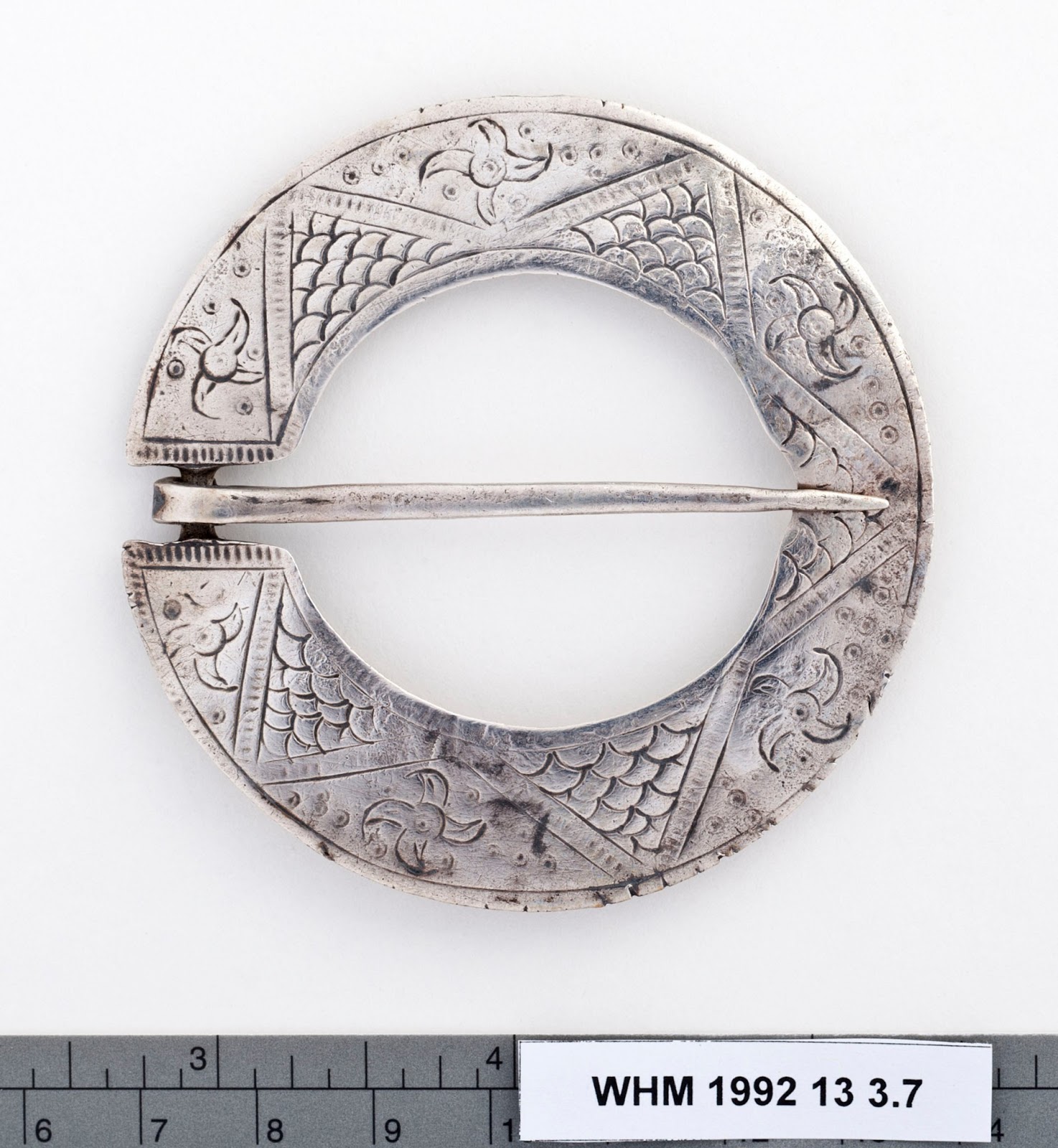
Silver Ring Brooch, West Highland Museum
Images
NMS objects © National Museums of Scotland
WHM objects  © Carsten Flieger 

Friday, 12 April 2013

Objects in Focus: Stone Font


In the National Museum of Scotland, Edinburgh a handful of objects collected by Carmicahel are on display: a baptismal font, a stone font and a Pictish stone. Carmichael's own notes explain where the stone font was found and the particular curing beliefs associated with it.  
Stone font
The small primitive porous looking font is from Christ's Burying Ground (Cladh Chriost) in the Island of Pabbay, Barra. 

Like the other islands of Barra, Pabbay is extremely rugged and precipitous and except during settled weather inapproachable on account of the Atlantic surf. On the south east side of the island there is an open bay. Behind this surf-beaten bay and in front of this glaciated hill beyond is a semicircular valley the bottom of which on the north side is composed of deep accumulated sand drift. 

This was formerly covered with bent (muran) and other grasses but the surface breaks caused by the winter storms have been inattended to of late years, the winter winds have swept away the sand to a great depth leaving studded over the valley high cone-like mounds as monuments of neglect. Cladh Chriost is one of these cone-like mounds. It is about thirty feet high and composed or built up of many successive and distinctive layers of sand, like so many different pieces of bleached and unbleached cotton on a drapers shelf and pointing to different periods of formation. 

Its base has already become considerably hard and solid thus affording us the late and interesting opportunity of examining the slow and silent yet sure and inevitable process by which Time converts the flying particles of sand into hard and solid rock. Had no fortuitous circumstances prevented this sand mound would be converted into sand stone rock, in which would be embedded at various distances from the surface well preserved human remains, some of them surrounded by rows of carefully selected polished pebbles from the strand, and others by irregularly coarse common moor stones from the hill; innumerable bits of cinerary urns, of different manufactures and evidently of different periods with pins and needles, of bone, bronze and brass.

Stone font
And in the event of these hard memorials of man surviving like the tender lady from the process of petrefaction, perchance some future Hugh Miller might arise in the distant ages to draw therefrom lessons of utility instruction and wisdom.

A stream flows from the scariated hill behind which strikes during spates with considerable force against the rear of Cladh Chriost after which it skirts round the base thereof undermining and carrying in its sacrilegious course, the crumbling mound of sand, human remains, and human memorials, in one confused mass, into the continuous and tumbling, toiling, troubles sea below.

Embedded in the grassy sandy summit of this disused and neglected burying ground, this simple font rested for ages. But having been lost to sight of late, a search was made for it two years ago, at my request which resulted in finding it in the bed of the stream beneath, upon which it was obligingly transmitted to me to Lochmaddy.

This font was for centuries an object of credulous belief to the inhabitants of Pabbay and the other southern Isles of Barra. These simple people implicitly believed that the touch of this font like that of another stone in S. Mary’s burying ground (Cladh Naomh Moire) in the neighbouring island of Bearnaray (Barra-Head) was efficacious in preventing and removing many mental and physical disorders incident to themselves and their flocks. The lixivium found in the font was considered doubly consecrated, firstly through contact with the already consecrated font, and secondly through the friendly agency of some invisible and mysterious power that presided over the scene. The virtues of this salinated water were deemed secondary only to those of the water consecrated by the priest. 

The people rubbed their bodies and their cattle with the font and sprinkled themselves and their flocks with the water contained therein, for the cure of certain bodily ailments and for the prevention of specific acts of witchcraft. And when this ceremony was duly performed with the necessary amount of formality and with the necessary admixture of pagan and christian rites, the people firmly believed that creative spirits of the air, nor the witches of the earth, nor the mermaids of the deep surrounding sea could infuse or molest them. 
Pabbay, Barra
A charm so potent could not be otherwise than an object of deep awe and interest among the hardy, simple and kind hearted people possessing it nor do I doubt but an attempt to remove it eighty or a hundred years ago would have been stoutly resisted and would probably result in serious consequences. But – “Old times are changed, old manners gone, A stranger fills the Stewarts’ throne; The bigots of an iron time, Had called these harmless acts a crime.” 

For a number of years past the belief in the virtues of this charm has been falling into abeyance and now only two old men as far as I know can give an intelligible account of the faded glories of the primitive little font. 

Now, the next time you visit the museum on Chambers Street keep an eye out for this font!

Reference
GB 237 Coll-97 CW457
Images
Font: © National Museums of Scotland
Pabbay: © RCAHMS

Stone whorls WHM 1992 13 2.4

Stone whorls WHM 1992 13 2.4
Stone whorls collected by Alexander Carmichael, held by West Highland Museum (ref. WHM 1992 13 2.4). [© carstenflieger.com]